
Let me tell you something that took me an embarrassingly long time to figure out.
For years, I avoided Darjeeling in December. Too cold, I told myself. Too foggy. The kind of trip where you spend three days wrapped in every piece of clothing you own, staring at a grey wall of mist from your hotel window, waiting for mountains that never show up.
Then a friend who knows the hills better than anyone I’ve met said something that changed my thinking entirely. She said — go in December, go early in the morning, and don’t complain about the cold. Just go.
So I went. And I understood immediately what all the fuss was about.
The sky that December morning at Tiger Hill was not the sky I knew from photographs. It was deeper. Sharper. The kind of blue that seems almost artificially saturated, the kind you think only exists in post-processed travel images until you’re standing in it at six in the morning with your breath making little clouds and Kanchenjunga filling the entire horizon like something placed there specifically to make you feel small in the best possible way.
December in Darjeeling is not for everyone. But for the right kind of traveller — the one who can handle cold, who finds beauty in quietness, who doesn’t need their hill station to be warm and easy — it might just be the most extraordinary version of this place you’ll ever experience.
Here’s everything you need to know.
What the Weather Actually Does
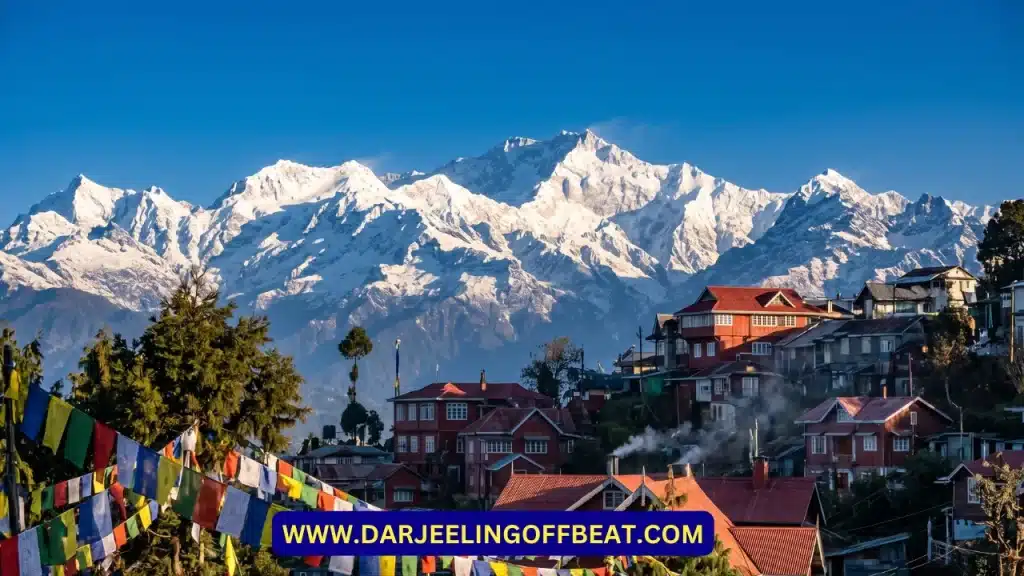
The first thing most people want to know about December in Darjeeling is how cold it gets. The honest answer is — cold enough that you need to take it seriously, but not so cold that it becomes a problem if you’ve packed properly.
Daytime temperatures generally range from 8°C to 12°C. On a clear, sunny December afternoon, with the light coming warm and low across the hills, it can feel almost pleasant — the kind of cold where a good fleece and a cup of tea in your hand is all you need to be perfectly comfortable walking around Mall Road or through a tea garden. The sun at this altitude has a particular quality to it in winter. It feels close. Direct. You’ll want sunscreen even though your instinct says otherwise.
Nights are a different conversation. After dark, temperatures regularly drop to 2°C or 3°C, and on clear nights — which December tends to produce a lot of — it can push toward zero. The cold doesn’t creep up on you. It arrives decisively, usually around sunset, and by eight in the evening, you’ll understand why every heritage hotel in Darjeeling still maintains its old wood-burning bukharis. There is no substitute for a fire when the temperature drops like that.
The mornings are where it gets genuinely dramatic. If you’re planning to go to Tiger Hill for sunrise — and you should — you’ll be leaving your hotel sometime around 4 AM. At that hour, in December, Darjeeling is properly, seriously cold. We’re talking thermals, fleece, heavy jacket, gloves, hat, the whole assembly. People who show up underprepared tend to remember it. Not fondly.
What December gives you in exchange for this cold is something genuinely rare in the Eastern Himalayas — clarity. The dry winter air that comes rolling down from the Tibetan Plateau takes the atmospheric haze with it and leaves behind a visibility that photographers specifically plan trips around. The Kanchenjunga massif, which spends much of the year partially obscured by cloud, becomes a permanent, extraordinary fixture on the horizon. On good December mornings, it looks close enough to touch — the snow on the upper ridges so sharp and white against the blue sky that it barely looks real.
Rain is not something you need to worry much about in December. Most years, the month produces only a handful of rainy days, and these tend to be brief and light. The landslides that make monsoon travel so unpredictable are almost absent. Roads are open, reliable, and — apart from the occasional morning frost on the higher sections — perfectly drivable.
Snowfall inside Darjeeling town is possible but genuinely uncommon in December. If it happens, it transforms the place into something from a storybook — the colonial architecture frosted white, smoke rising from every chimney, the streets quiet and still. But don’t plan your trip around it happening in town. What you can count on is snow at Sandakphu and the higher elevations of Singalila, which often see their first serious snowfall by mid-December. If a proper white landscape is what you’re after, that’s where you go.
Getting There — The Honest Route Guide
Most people coming to Darjeeling in December are travelling from somewhere in the plains — Kolkata, Delhi, or the smaller cities of West Bengal. The journey has a few different shapes depending on where you’re starting from, but the fundamental logic is the same for almost everyone: get yourself to New Jalpaiguri (NJP) first, and then deal with the mountain road from there.
The train is the best option for the plains section. From Kolkata, several overnight trains run to NJP, and the journey takes roughly eight to nine hours depending on the service. The Darjeeling Mail is the classic choice — there’s something appropriate about arriving in Darjeeling by the same railway line that colonial travellers once used. From Delhi, the journey is longer, around twenty-two to twenty-four hours, but the sleeper trains are comfortable if you book well in advance. For anyone coming from Bardhaman or the smaller West Bengal cities, the NJP connection is straightforward — the Vande Bharat Express has cut journey times considerably.
From NJP, you have choices. A private taxi — an Innova or Xylo is most common — will get you to Darjeeling in three to four hours and costs somewhere between ₹2,500 and ₹3,500 depending on the vehicle and the season. December is peak season, so expect prices to be at the higher end. Shared jeeps from the Siliguri stand are dramatically cheaper (around ₹300 to ₹400 per person) but they carry up to ten passengers and the seats are not designed for comfort on a winding mountain road. If you’re travelling light and on a tight budget, they work. If you have luggage and value your back, private is worth the difference.
One thing worth knowing, especially if you’re driving through the plains section in December: fog. The highways between southern West Bengal and Siliguri — NH12 and NH27, particularly, can experience dense fog in the early morning hours. We’re talking genuine reduced-visibility fog, the kind where you slow down, switch to low beams (not high beams, which reflect off the water droplets and make things worse), and follow the edge lines on the road more than you follow what’s in front of you. If you’re in a private car, tell your driver to leave NJP in daylight, not before dawn, to avoid the worst of it. Most experienced drivers in this region know the fog situation well and will time things accordingly — but it doesn’t hurt to mention it.
Once you’re on the mountain road, the ascent itself takes care of any lingering highway boredom quite efficiently. The Hill Cart Road through Sukna, Rangtong, and Kurseong is one of the more dramatic approaches to any hill station in India. In December, with clear weather, the views on the way up can be genuinely stunning — the plains falling away behind you, the hills closing in ahead, and on a clear day, the first glimpse of snow on distant peaks appearing above the treeline.
If you’re flying, Bagdogra Airport near Siliguri is the closest. From there, it’s the same taxi situation as from NJP — around three to four hours by road.
The Toy Train — Yes, You Should Do It
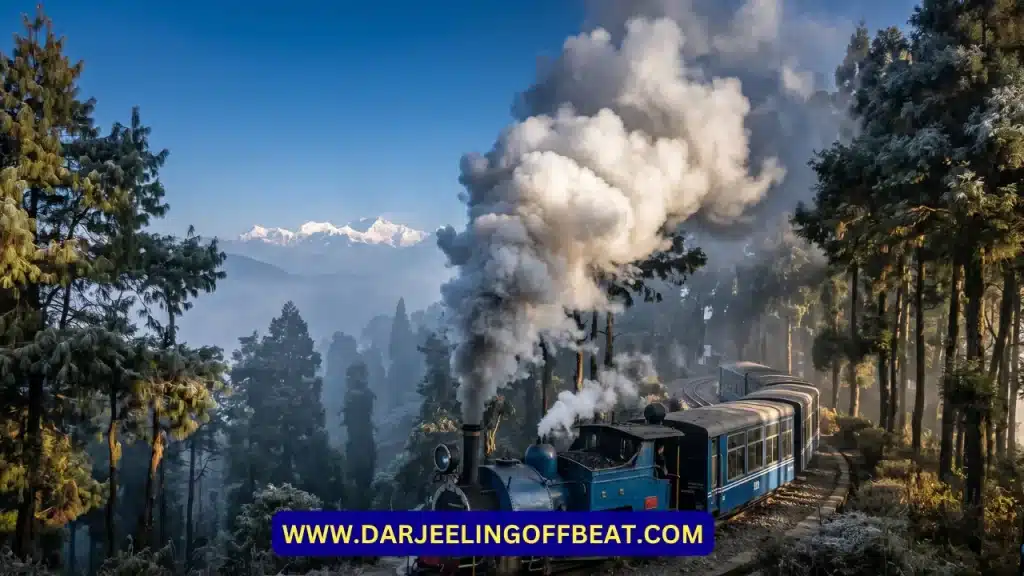
The Darjeeling Himalayan Railway is one of those rare things that lives up to its reputation entirely. It’s a UNESCO World Heritage site, which sounds impressive in an abstract way, but the real reason to ride it is much simpler: it is one of the most beautiful train journeys in the country, and in December, it’s something else entirely.
The most popular option is the joyride — a roughly two-hour round trip between Darjeeling station and Ghum, which sits at 2,258 metres and holds the title of India’s highest railway station. The steam version of this ride, pulled by a vintage B-class locomotive, is the one worth paying a little extra for. The coal smoke, the whistle, the almost impossibly slow pace as the tiny train navigates the hairpin curves — all of it adds up to an experience that feels completely outside normal time.
In December, the cold makes the steam more dramatic. You can see it clearly against the blue sky, mingling with the mist in the valleys below. The train passes through pine forests that are perfectly still in the cold air. It loops around the Batasia Loop — where, on a clear day, Kanchenjunga sits directly in your line of sight as you complete the curve — in a way that makes you understand why people come back to this ride year after year.
The full route from NJP to Darjeeling — all 88 kilometres of it — is a longer commitment but an extraordinary one. Book through IRCTC well in advance if you’re visiting around Christmas or New Year; these tickets disappear fast. Some services now run Vistadome coaches with large windows and glass roofs, which work particularly well in December when you want the views without sitting in the cold wind.
Tickets for the joyride start around ₹1,000 for the diesel version and ₹1,500 for the steam. Book online and book early — walk-in availability in peak season is unreliable.
Christmas in Darjeeling — The Part Nobody Fully Prepares You For
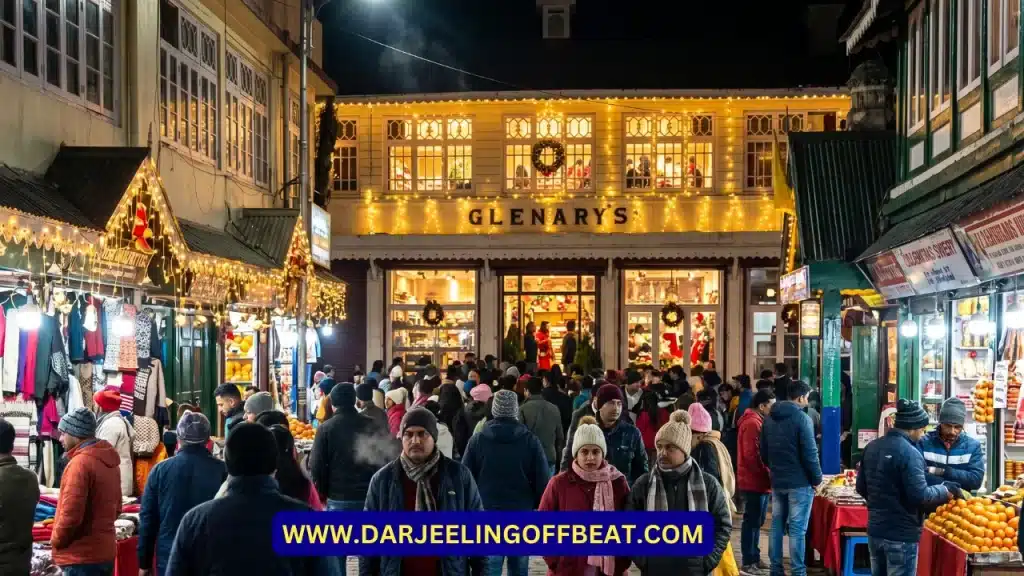
Here’s something that surprises a lot of first-time December visitors: Darjeeling does Christmas properly.
This isn’t the commercialised, decoration-heavy version of Christmas you find in malls in Kolkata or Delhi. It’s something quieter and, to be honest, more genuinely festive. The town has a deep Christian community, a collection of beautiful old churches built during the British era, and a long tradition of treating December 25th as a real celebration rather than just a retail event.
The centrepiece for most visitors is Glenary’s — the bakery and restaurant that has been operating since 1875 and occupies a building on the main road that has seen more Darjeeling history than most people can imagine. In December, Glenary’s becomes the kind of place you want to spend an hour or two without rushing. The smell of fresh-baked goods — breads, cakes, pastries — hits you before you even open the door. Their Christmas roast is famous, and deservedly so. Roast chicken, beef, duck, all the trimmings — served in a dining room with live carols and the sort of warm, slightly chaotic atmosphere that a good Christmas dinner is supposed to have. Book a table if you’re going on Christmas Eve or Christmas Day. They fill.
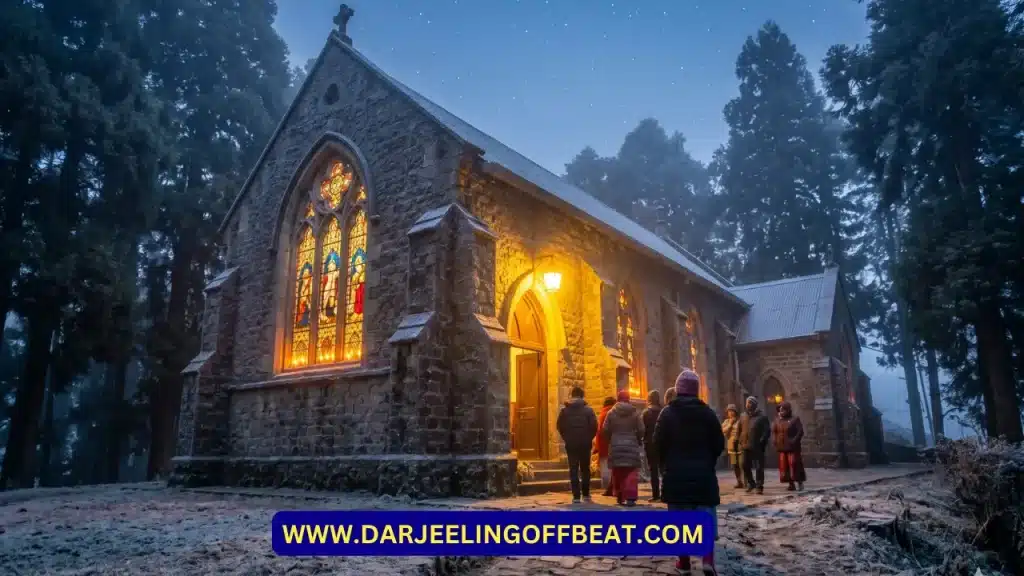
St. Andrew’s Church, built in the 19th century, holds midnight mass on Christmas Eve. It’s worth attending even if you’re not Christian — there’s something deeply moving about a candlelit service in a colonial-era stone church at altitude, with the cold night air outside and the sound of carols inside and the mountains presumably somewhere behind the darkness. It fills up, so arrive early.
Mall Road on Christmas Eve is a sensory experience in itself. Stalls selling woollen goods, handmade ornaments, and local sweets. Families walking in groups, everyone bundled up, breath visible in the cold air. The lights strung along the storefronts. The town feels, genuinely, like somewhere celebrating something rather than performing a celebration for tourists.
If you’re a heritage hotel person, December is when those properties earn every rupee of their rates. The Windamere — established in 1841, still running its famous coal bukharis, still serving afternoon tea with a formality that has survived everything history threw at it — is at its absolute best in December. Sitting in the Windamere lounge with a fire in the corner and tea in proper china while the cold does its thing outside the window is an experience that requires no justification to anyone who loves travel. The Elgin is similarly good, with its fireplaces and its slightly faded colonial grandeur that manages to feel charming rather than tired.
New Year’s Eve at 7,000 Feet
New Year’s Eve in Darjeeling is, depending entirely on your preferences, either the perfect way to end a year or something to plan around carefully.
The town comes alive in a way that’s genuinely festive but never overwhelming. The Gymkhana Club — one of those institutions that seems to have existed outside time for the better part of a century — runs an annual New Year’s Eve gathering for members and guests that starts early in the evening and leans heavily into the kind of faded-glory atmosphere that Darjeeling does better than almost anywhere in India. It’s formal, it’s warm, and it’s worth it.
The newer luxury hotels — the Ramada and similar properties — put on full gala dinners with live music, buffets, and the organised celebrations that large hotels do well when they do them well. These run late and are well-suited to groups or to people who want the full festive evening experience without having to organise anything themselves.
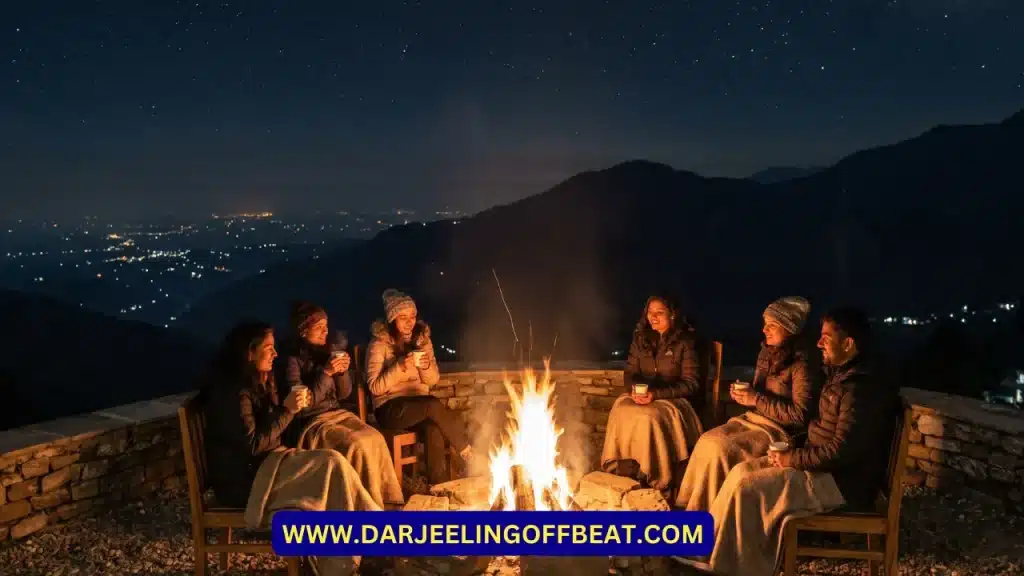
But honestly? The version of New Year’s Eve in Darjeeling that I would point most people toward is simpler than any of that. A bonfire. A good boutique hotel or homestay that organises one. A handful of other guests you’ve probably already started talking to over dinner in the preceding days. Hot drinks, blankets, possibly a guitar, the kind of conversation that only happens when people are slightly cold and slightly far from home and have no particular place to be.
There are few better ways to watch a year turn over than from a hillside in Darjeeling, the plains lit up distantly below, the mountains dark and enormous above, a fire going, the cold doing what cold does.
Where to Stay — The Real Breakdown

The accommodation situation in Darjeeling in December requires a little more planning than at other times of year, for two reasons. First, it’s peak season — the Christmas-New Year window especially fills up months in advance. Second, not all rooms in Darjeeling are created equal when it comes to warmth, and this matters considerably more in December than in April.
At the heritage end, the Windamere and the Elgin are both genuinely worth their rates in December, specifically because they were built for this season. The bukharis at the Windamere — coal-burning stoves that radiate a deep, bone-warming heat — are not a gimmick or an aesthetic choice. They work in a way that modern electric heaters often don’t, especially in the oldest rooms of the building, which have high ceilings and stone floors. If you’re going in December and you can afford it, the Windamere in winter is one of those travel experiences that stays with you.
For the 5-star crowd, the Taj Chia Kutir — set within the Makaibari Tea Estate — offers the opposite of heritage roughing-it. Proper heating, beautiful rooms, extraordinary setting. It’s about 30 kilometres from Darjeeling town, which means you’re trading proximity to Mall Road for space and quiet and the experience of waking up inside a working tea estate. In December, with the gardens dormant and the estate empty of tourists, it feels like having a private mountain resort to yourself.
Mid-range options are plentiful and generally good. Look specifically for rooms with wooden flooring — it insulates against the cold better than stone or tile — and ask directly whether the property provides electric blankets or portable heaters. Most reputable mid-range hotels and homestays do, but it’s worth confirming rather than assuming. A cold room at 3 AM at altitude is not something you want to discover after check-in.
For budget travellers, Darjeeling has a reasonable selection of guesthouses that are both affordable and honest about what they offer. The key questions to ask are: is there hot water in the mornings (not always guaranteed), is there any form of heating in the room, and how many blankets come with the bed. Get clear answers to all three before committing.
Book everything in advance. Not vaguely in advance — properly in advance. The Christmas week and New Year week are genuinely fully booked at the good properties, sometimes by October. If you’re reading this in November and planning a December trip, start calling today.
The Orange Valley — Sittong as a Side Trip
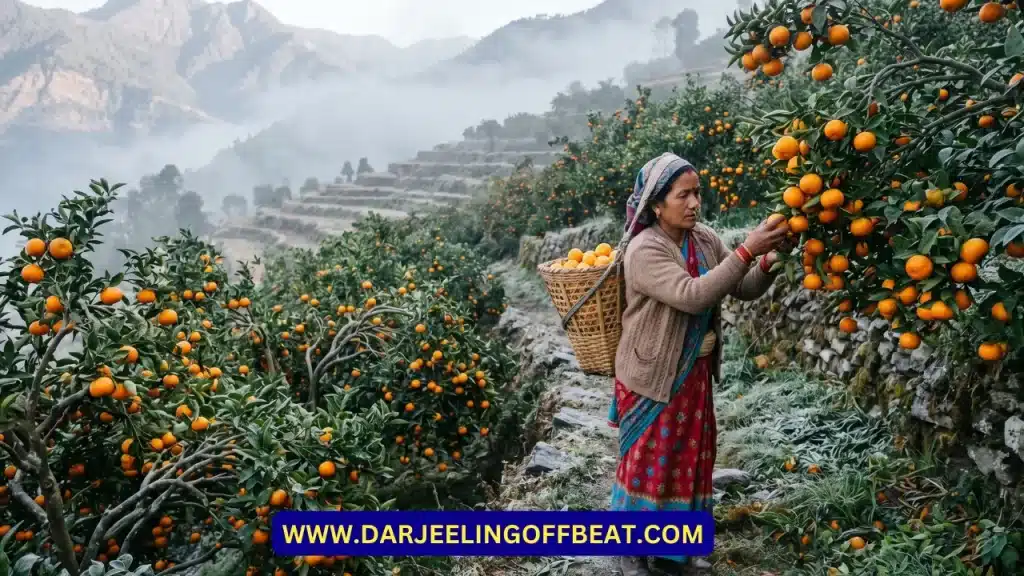
December is orange season in North Bengal, and if you’re spending time around Darjeeling this month, taking a day or two to visit Sittong is one of the better decisions you can make.
Sittong — a cluster of villages about two and a half hours from Darjeeling, sitting between Kurseong and Mirik — transforms in December as the mandarin orange harvest comes in. The orchards cover the terraced hillsides in dense, gnarled rows, the fruit hanging heavy and bright orange against the cold green of the trees. You can walk through them, buy oranges by the basketful for almost nothing, eat one still cold from the tree while looking out at a valley full of mist, and understand why people make specific trips to do exactly this.
The accommodation in Sittong is homestay-based — local families with two or three rooms available, home-cooked meals included, prices that feel almost unreasonably reasonable. It’s not comfortable in a hotel sense. It’s comfortable in a more fundamental, harder-to-manufacture sense — the feeling of being genuinely welcomed into someone’s home and fed well and left to move at whatever pace suits you.
December is the peak season for Sittong too, so book homestays ahead of time. Network connectivity can be patchy — treat this as a feature rather than a bug. Take the back road from Kurseong if your driver knows it. The drive through the valley in December is beautiful enough to be part of the experience.
Food — What December Tastes Like in Darjeeling
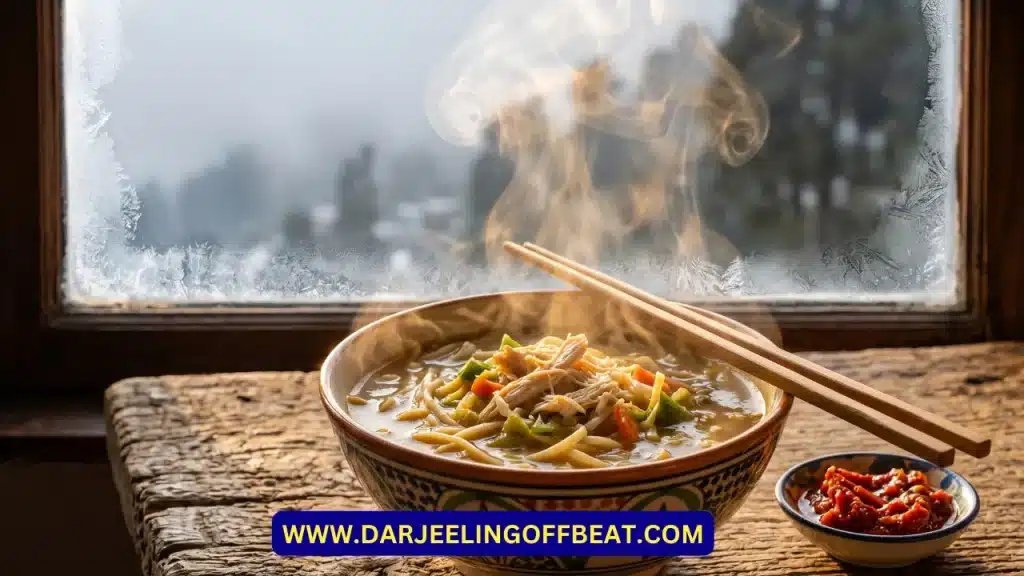
Cold changes what you want to eat, and Darjeeling’s food culture understands this deeply. The local culinary tradition is a layered mix of Tibetan, Nepali, and Gorkha influences, and almost all of it leans toward warmth, density, and heat in the best possible ways.
Thukpa is where you start. This Tibetan noodle soup — noodles, vegetables, meat if you want it, in a broth built on ginger and garlic and bone — is the food that December in Darjeeling was made for. A large bowl of thukpa at one of the small restaurants around Chowrasta costs almost nothing and does more for your body temperature than a coat. Find a place that makes it with pork broth if you eat meat. It’s extraordinary.
Momos are everywhere, and they’re consistently good, especially the steamed version served with the hot red chilli achar that local establishments make differently from each other in ways that become interesting once you’ve tried a few. In December, the vendors who sell momos on the street usually have something steaming going at all times, and buying a plate and eating it standing on Mall Road in the cold is one of those simple, perfect Darjeeling moments.
Less talked about but worth specifically seeking out: gundruk soup. Gundruk is fermented leafy greens — mustard or radish leaves — that have been dried and preserved, and the soup made from it is tangy and deeply flavoured and warming in a way that feels like it was designed for exactly this climate. It’s a traditional Nepali dish and it’s not always on tourist menus, so ask specifically.
Darjeeling tea in December is its own category. The gardens are dormant — no first flush or second flush to harvest — but the town’s tea rooms and hotels have stock from earlier in the year, and drinking a well-made Darjeeling tea in a proper cup in one of the heritage hotels while looking out at the mountains is an experience that justifies the journey by itself. The Windamere’s tea service is the classic option. Glenary’s is more casual but consistently good. There are smaller tea boutiques on and around Mall Road worth exploring if you want to take tea home as a gift.
Chang, or Tongba, is the local fermented millet drink served in a bamboo container with warm water poured over the grains and a bamboo pipe to drink through. It’s warming, it’s low-alcohol, it’s deeply local, and it’s very much a December drink. Some of the smaller local restaurants serve it. Ask. It’s worth the slight effort of finding it.
What to Wear — The Practical Guide
This section exists because under-packing for Darjeeling in December is genuinely one of the most common mistakes people make, and it turns what should be a wonderful trip into a cold, miserable one.
The layering system is the only approach that works here, because the temperature difference between 4 AM at Tiger Hill and 2 PM on Mall Road in the sunshine is significant enough that you need to be able to adjust as the day moves.
Start with thermal inners — proper wool or good synthetic thermals, not the cotton versions that look similar but don’t function the same way. These go on first and stay on all day. Over that, a fleece or a thick sweater for the middle layer. Over that, a proper winter jacket — windproof, ideally water resistant, actually warm rather than just styled to look warm. This combination will carry you through most of December in Darjeeling comfortably.
For the Tiger Hill morning specifically, add to that a woollen hat that covers your ears, gloves, and a scarf or neck warmer. The wind at the viewpoint in the dark before sunrise is biting. People who ignore this advice are easy to identify at Tiger Hill — they’re the ones huddled in the corner looking regretful while everyone else is comfortably watching the light hit the peaks.
Good socks. Seriously. Cold feet make everything worse. Wool socks, two pairs if you have them. And shoes or boots with some grip — the paths around Darjeeling can be slippery in the mornings when frost has formed on steps and paving.
Sunscreen is not optional. The winter sun at altitude is genuinely strong, and the cold air makes you less aware that you’re burning. Put it on before the Tiger Hill visit if nothing else. Your skin will thank you.
Lip balm. Hand cream. The air is dry, the cold is drying, and the inside of most heated hotel rooms is drier still. Your skin will protest in December at altitude if you don’t give it some help. Keep a small moisturiser in your bag and use it.
A Few Things That Will Make the Trip Better
Carry cash. The ATMs in the Darjeeling hill area are reliable most of the time, but in the peak December season, they sometimes run dry before they’re restocked, and digital payment options can be patchy. A reasonable amount of cash at the start of your trip saves you the anxious hunt for a working ATM on Christmas Eve.
Motion sickness medicine — specifically Avomine or a similar tablet taken the night before your hill journey. The mountain roads have hairpin turns that affect some people even if they’ve never been prone to motion sickness before. Take the precaution. It weighs nothing and it can make a three-hour journey much more pleasant.
Book the Tiger Hill transport in advance through your hotel if possible. December mornings see a lot of cars heading up at the same time, and the good operators fill early. Your hotel front desk can usually arrange this, and it’s worth asking the evening before rather than scrambling at 3:30 AM.
Get to Batasia Loop at some point — not just during the toy train joyride but also on foot if you can. In December, on a clear day, the garden at Batasia Loop frames Kanchenjunga in a way that most photographs of the place don’t fully capture. It’s quieter than Tiger Hill, more accessible, and the views can be equally extraordinary.
Give yourself time to simply walk. The best thing about Darjeeling in December is the walking through the tea gardens below town, along the Observatory Hill path, up through the quieter lanes above Mall Road where the houses are, and the views between them catch you off-guard repeatedly. The town rewards slow movement. Don’t fill every hour with organised sightseeing. Let some of it be unplanned.
Who December in Darjeeling is Really For
I want to be honest here, because not every trip suits every traveller.
December in Darjeeling is not the right choice for someone who finds cold weather miserable rather than manageable. It’s not ideal if you need guaranteed snowfall inside the town itself. It’s not the trip to take if you’re hoping for the festival energy of October or the blooming rhododendrons of March.
What it is, without question, is the best version of Darjeeling for mountain views. For clarity of sky and air. For the particular feeling of a hill town that has slowed down into its winter self — quieter than peak season, more honest, more itself. For Christmas in a place where Christmas still carries some genuine weight. For New Year’s Eve, around a bonfire at altitude with strangers who’ve quickly stopped feeling like strangers.
For the kind of traveller who dresses well for the cold and finds beauty in the sharp, cold, clear version of the world rather than the warm, lush, busy version — December is not a compromise. It’s the best time.
Go early in the morning. Take the cold seriously. Stay long enough to feel the town shift from pre-Christmas festive into the quieter, more contemplative days that follow. Drink the tea. Eat the thukpa. Stand at Tiger Hill in the dark and wait for the light to do what it does to those peaks.
Then come back in March if you want the flowers. You’ll want to come back.
Visited Darjeeling in December? Tell us what you found. The comments section exists for exactly this — real experiences from real travellers who know something the rest of us don’t yet.
Q.1: Is December a good time to visit Darjeeling?
Ans: Yes, December is one of the best times to visit Darjeeling. The skies are exceptionally clear, mountain views are at their sharpest, and the town has a genuine festive energy around Christmas and New Year. It’s cold but completely manageable with the right clothing.
Q.2: How cold does Darjeeling get in December?
Ans: Daytime temperatures range between 8°C and 12°C — comfortable for sightseeing with warm layers. Nights drop to 2°C–7°C. Early mornings at Tiger Hill can feel close to freezing, so thermals, a heavy jacket, gloves, and a woollen hat are non-negotiable.
Q.3: Does it snow in Darjeeling in December?
Ans: Snowfall inside Darjeeling town in December is possible but uncommon. However, higher elevations like Sandakphu (3,636 m) and Tumling regularly receive snow by mid-December. For a guaranteed snowy landscape, plan a trip to Sandakphu rather than waiting for snow on Mall Road.
Q.4: What is the best way to reach Darjeeling in December?
Ans: Take a train to New Jalpaiguri (NJP) — overnight trains from Kolkata take 8–9 hours. From NJP, hire a private taxi to Darjeeling (3–4 hours, ₹2,500–₹3,500). Private is recommended over shared jeeps in peak season for comfort and luggage convenience.
Q.5: Is the Darjeeling toy train running in December?
Ans: Yes, the Darjeeling Himalayan Railway runs throughout December. The 2-hour steam joyride between Darjeeling and Ghum is particularly magical in winter. Book tickets on IRCTC well in advance — Christmas and New Year slots sell out weeks ahead.
Q.6: What should I pack for Darjeeling in December?
Ans: Pack in three layers — thermal inners, a fleece or woollen sweater, and a windproof heavy jacket. Add woollen socks, gloves, a hat covering your ears, and a scarf. Carry sunscreen (UV is strong at altitude), lip balm, moisturiser, and motion sickness tablets for the mountain road.
Q.7: Which hotels are best in Darjeeling for December?
Ans: The Windamere Hotel (famous for traditional coal bukharis) and The Elgin (heritage fireplaces) are top picks for winter warmth and atmosphere. For luxury, Taj Chia Kutir at Makaibari Tea Estate is excellent. Book 2–3 months ahead — Christmas week fills up fast at all good properties.
Q.8: What food should I try in Darjeeling in December?
Ans: Thukpa (Tibetan noodle soup) is the essential winter dish — warming, filling, and available everywhere. Steamed momos with hot chili achar are perfect street food. Try gundruk soup for a traditional local experience. Finish with a proper cup of Darjeeling tea at Glenary’s or the Windamere.
Q.9: Is Christmas special in Darjeeling?
Ans: Absolutely. Darjeeling celebrates Christmas genuinely — not just commercially. Glenary’s famous Christmas Roast Feast, midnight mass at the 19th-century St. Andrew’s Church, decorated Mall Road stalls, and bonfire evenings at heritage hotels all make it one of the most atmospheric Christmas destinations in India.
Q.10: Is Darjeeling safe to visit in December?
Ans: Yes, December is one of the safest months to travel to Darjeeling. Monsoon landslides are over, roads are clear and open, and rainfall is minimal, averaging only around 4 days. The only caution is dense fog on the plains highways (NH12, NH27) in early mornings — travel in daylight and use low-beam headlights if driving.
- Kashyem Kaman Kalimpong Teesta Rangpo Confluence View 2026: The Cedar Ridge
 Kashyem Kaman Kalimpong Teesta Rangpo confluence view — Teesta-Rangpo confluence below and Kanchenjunga above — plus Cinchona heritage trails and cedar forest homestays at ₹1,250/day. There is a specific kind of view that requires exactly the right elevation — too high and the cloud covers everything, too low and the angle is wrong. Kashyem Kaman …
 - Kalijhora Homestay & Teesta Travel Guide: How a Picnic Spot Turned Into North Bengal’s Quietest Adventure HubKalijhora homestay guide: where to stay near the Teesta, rafting routes & prices, Panboo ridge views, and everything to plan your North Bengal trip If you’ve driven up NH10 from Siliguri toward Kalimpong or Darjeeling, you’ve passed through Kalijhora without necessarily noticing it. That’s kind of the point. It sits about 28 kilometres north of …
- Goiri Gaon, Kalimpong: The Village the Forest Kept Secret — Now With the Full StoryGoiri Gaon Kalimpong Neora Valley offbeat — red panda corridor, Maria Busty 1891 church, Pedong Silk Route ruins, and homestay-only model. Complete offbeat guide inside. There are places in the Eastern Himalayas that exist in a kind of geographical grace — tucked far enough from the main roads that the noise of modern hill tourism …
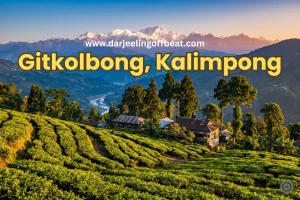
- Gitkolbong Village Kalimpong: The Village That Climbs From River to RidgeGitkolbong village Kalimpong near Lava, with tea plantations, the Gitkhola river, and a ridge trail to Gitkolbong Top with Kanchenjunga views. Complete offbeat travel guide inside. Some places reveal themselves slowly. You arrive, and the first impression is modest — a quiet mountain village, some terraced farmland, a stream you can hear before you see …
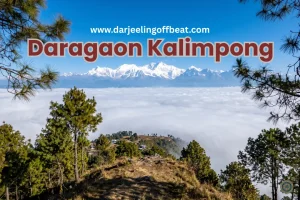
- Daragaon Kalimpong Kanchenjunga View Where the Clouds Stay Below YouDaragaon Kalimpong Kanchenjunga view— offers a rare sea-of-clouds sunrise view with the world’s third-highest peak floating above the Teesta valley. Complete travel guide inside. There’s a moment that happens at Daragaon — usually around six in the morning, usually in October or November — that people struggle to describe accurately afterwards. You’re standing at the …
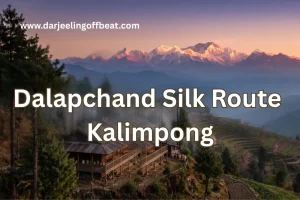
- Dalapchand Silk Route Kalimpong: Where West Bengal Meets SikkimSome destinations, like Dalapchand Silk Route Kalimpong, exist because someone put them on a map, and others exist because the landscape demanded them. Dalapchand is the second kind. Sitting right on the border zone between Kalimpong district in West Bengal and Pakyong district in East Sikkim, this quiet mountain hamlet occupies a genuinely rare position. …





North Bengal's offbeat magic is my muse. I find adventure in whispering waterfalls, vibrant village life, and breathtaking Himalayan vistas. Join me as I delve deeper, seeking stories and experiences beyond the mainstream, from Darjeeling's tea havens to the unexplored corners of this incredible region