
There’s a particular kind of travel moment that’s becoming genuinely rare — the kind where you arrive somewhere beautiful and realise, with a mix of disbelief and quiet gratitude, that you’re almost completely alone there.
No tour groups. No Instagram queue for the viewpoint. No touts. Just the smell of oranges in the cold air, a dog sleeping across the path, and an old woman hanging laundry on a line strung between two mandarin trees while mist rolls slowly and thick across the valley below.
Sittong —The Orange Village gave me that moment. And I’ve been nudging people toward it ever since.
So, Where Exactly Is Sittong?
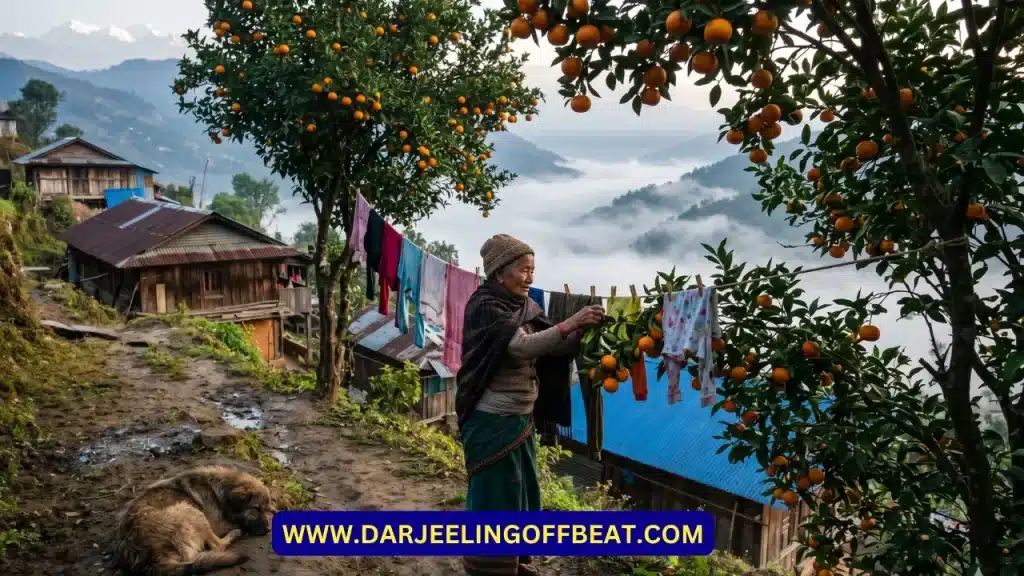
Sittong — sometimes spelt Sitong — is a small cluster of villages in the Darjeeling district of West Bengal, sitting roughly between Kurseong and Mirik at an altitude of about 4,500 to 5,000 feet. It’s about 30 kilometres from Kurseong town and perhaps 50 kilometres from Darjeeling, depending on which part of the Sittong valley you’re heading to.
It does not have a railway station. It does not have a famous viewpoint with a name. There is no heritage hotel, no celebrity chef’s restaurant, no rooftop bar with Kanchenjunga views and a cocktail menu. What it has, honestly, is something more valuable than any of that — it has been left almost entirely to itself.
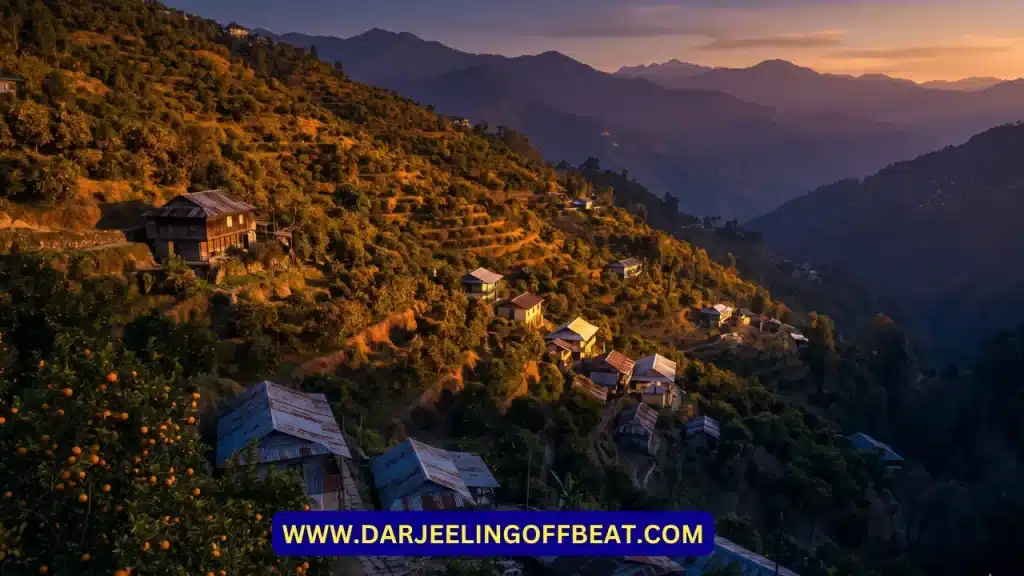
The area is divided into several micro-villages — Sittong 1, Sittong 2, Sittong 3, and so on — each a little settlement of timber and tin-roofed homes, homestays run by local families, small cardamom farms, and most famously, orange orchards. Hundreds and hundreds of orange trees terraced across the hillsides, so dense in places that the path through them becomes a kind of tunnel of green and gold.
The Oranges — Because That’s What Everyone Comes For First

The best time to visit Sittong —The Orange Village is between November and January. That’s when the mandarin oranges ripen, and the whole village transforms into something that feels almost theatrical — except it’s entirely, unselfconsciously real.
You walk through orchards where the fruit hangs low enough to brush against your shoulder. The trees are small, gnarled, old — nothing like the manicured citrus groves you’d see in a glossy travel magazine. These are working trees on working farms, tended by families who’ve been doing this for generations. The fruit is sweet and slightly tart in the way that mass-produced oranges never are, because these have cold nights and mountain air in them.
Locals sell oranges by the basket at prices that will make you want to buy three more than you can reasonably carry. Which you will. Because there is something about eating an orange that you just watched someone pull from a tree twenty feet away — the peel comes off in one piece, the juice is cold, and you’re standing on a hillside in the Himalayas looking out at fog and forest. It’s one of those small, perfect travel moments that costs almost nothing and stays with you unreasonably long.
Even if you visit outside the orange season, Sittong is beautiful. Spring brings wildflowers and rhododendrons. Monsoon turns everything an almost aggressive shade of green. But if you can time it, November to January is where the magic concentrates.
What Sittong Actually Feels Like
This is the part that’s hard to describe without sounding like you’re overselling it.
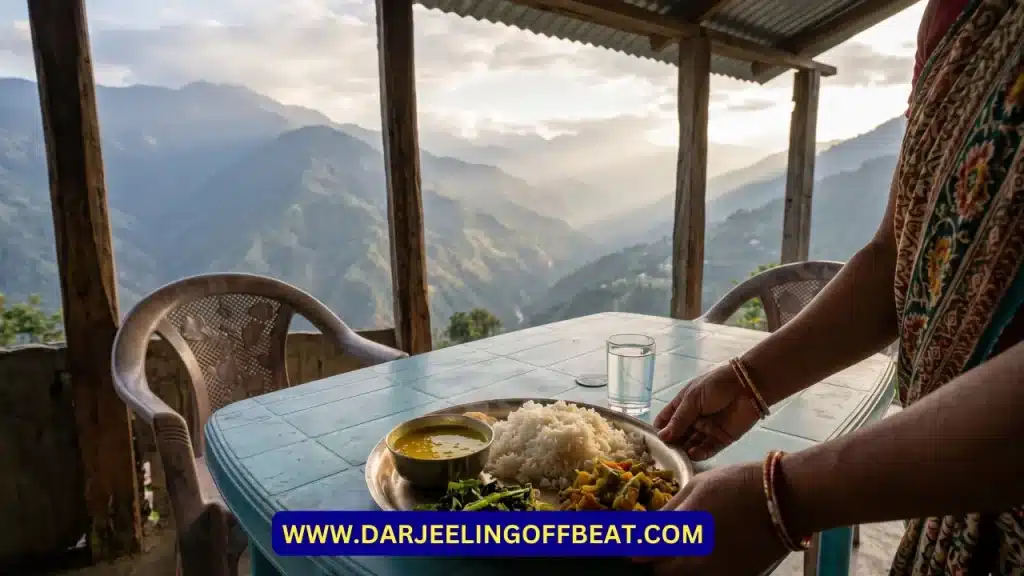
Sittong feels like North Bengal before tourism got hold of it. There’s no performance happening. Nobody has arranged the village for your comfort or convenience. The homestay families cook whatever they cook for themselves — and it is almost always delicious, because it’s real food made by people who know how to cook it, served at a plastic table on a porch with a valley view that five-star hotels would charge you five thousand rupees a night to look at.
The pace is entirely different from Darjeeling town. In Darjeeling, especially in peak season, there’s a constant low-level hum — taxis, tourists, the toy train whistle, the hawkers on Mall Road. Sittong has birdsong. The sound of water running somewhere below the path. Roosters. Wind in the orange trees.
You slow down here, almost without meaning to.
I remember sitting on the veranda of a homestay one morning, nursing a cup of tea that had come from leaves grown literally on the slope below where I was sitting, watching a thick bank of cloud fill the valley like something poured in slowly. A child from the family came and sat next to me without saying anything, also watching. We sat there for maybe twenty minutes. No one felt the need to break the silence. That doesn’t happen in many places.
The Birds — A Reason Unto Itself
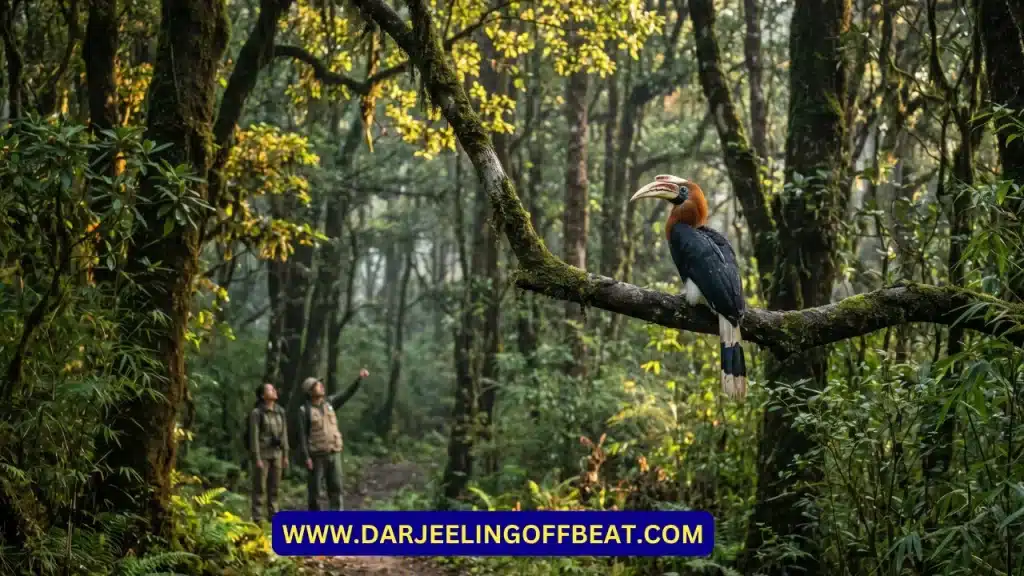
This is something that genuinely surprises people who visit Sittong without knowing about it: the birdlife here is extraordinary.
The forests around the Sittong valley are part of the broader Eastern Himalayan ecosystem, and they harbour species that serious birders travel from across the world to see. Rufous-necked hornbills. Kalij pheasants. Various species of laughingthrush. Warblers, sunbirds, babblers — the list goes on, and the local guides know it intimately.
If you’re a birder, Sittong is not a side trip. It’s a destination. The early morning walk along the forest trail starting from around Sittong 3 or heading toward the Mahananda buffer zone is genuinely one of the best birding walks in North Bengal. Take binoculars. Start before sunrise. Hire a local guide — they’ll hear the birds before you even wake up properly, and they know which trees attract which species and at which hour.
Even if you’re not a serious birder, waking up to the sound of the forest here does something good to you. There’s a scientific reason for that, apparently — something about certain bird frequencies and the nervous system — but honestly, you don’t need the science. You just need the experience.
Getting There: Sittong —The Orange Village
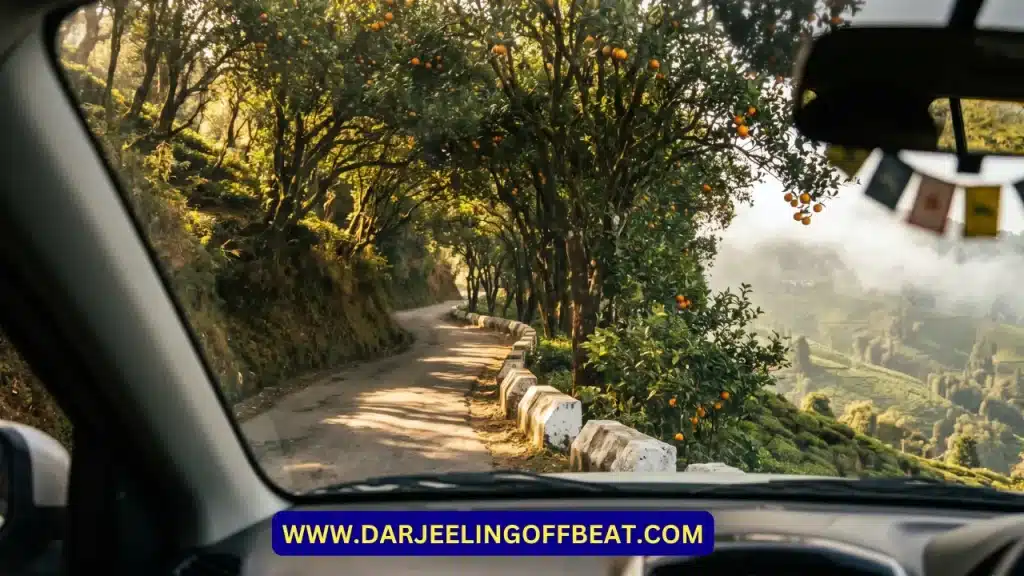
This is where people sometimes get nervous, and there’s no point pretending it’s effortless.
Sittong —The Orange Village is not on any major tourist circuit. There are no direct buses from Siliguri or Darjeeling that will drop you at a homestay door. The roads to get there are hill roads — narrow, occasionally rough, occasionally spectacular in ways that remind you exactly why you came.
The most practical approach is to hire a private car or cab from Siliguri, NJP, or Kurseong. From Kurseong, it’s about an hour and a half to two hours by car, depending on exactly where in the Sittong valley you’re headed. From Siliguri or NJP, budget around three to three and a half hours.
Tell your driver specifically which Sittong village or homestay you’re heading to, because the valley is spread across several settlements and the roads fork in ways that are not always obvious. Most homestay owners will give you detailed directions if you call ahead — and you should call ahead, because walk-in accommodation in Sittong is genuinely limited.
A shared jeep option exists from Kurseong to parts of the area, but the frequency is irregular, and timing can be unpredictable. If you’re travelling with luggage or have a specific schedule, private is the safer and frankly more pleasant choice. The drive through the Sittong valley on a clear day is beautiful enough to justify the cost on its own.
Where to Stay
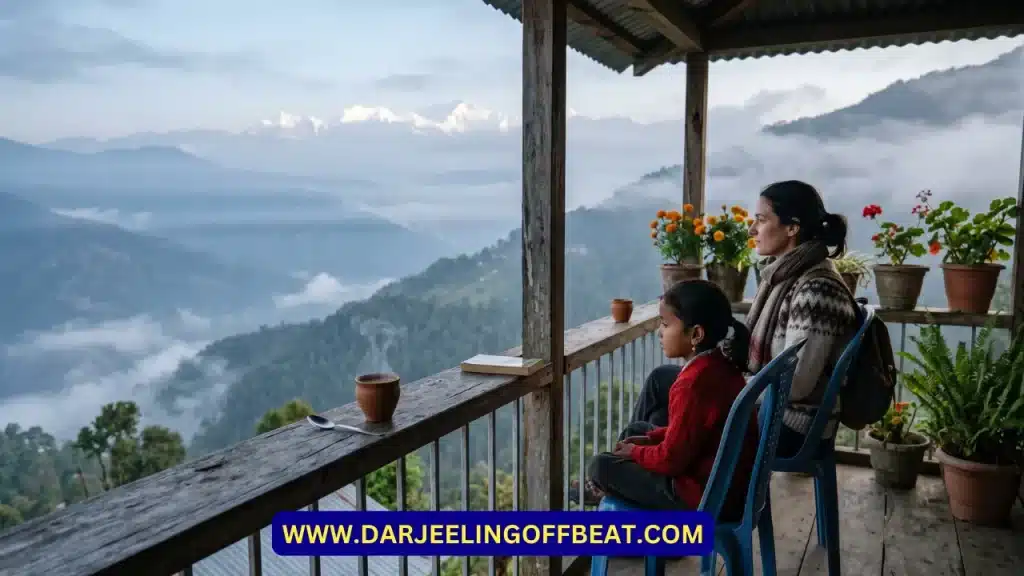
The accommodation in Sittong —The Orange Villageis almost entirely homestay-based, and this is not a downgrade — it’s the point.
Local families have opened their homes to travellers, mostly with two to four rooms available, shared bathrooms that are clean if basic, and home-cooked meals that are included in most packages. The cost is remarkably reasonable — somewhere between ₹800 and ₹1,500 per person, including meals, depending on the homestay and season.
What you’re paying for is not thread counts or room service. You’re paying to sit in someone’s home, eat their food, hear their stories if they’re in a sharing mood, and wake up to a view from your window that no hotel architect could have designed better.
A few homestays have built small cottages or additional rooms with more privacy, which suits couples particularly well. Ask specifically about view rooms — the difference between a room facing the valley and one facing the hillside above is considerable.
Book in advance. Not weeks in advance necessarily, but a few days at minimum, and definitely earlier if you’re visiting in the November-January orange season when whatever limited rooms exist fill up. Most homestay owners are reachable by phone, and many are on WhatsApp. Google and Booking.com have listings for some of them, though calling directly often gets you a better rate and more accurate information about current availability.
What to Do (And What Not to Expect)
Let’s be straightforward about this: Sittong —The Orange Village is not an activities destination. There are no adventure sports packages, no guided tour buses, no designated “attractions” with ticket counters and entry fees.
What there is — and what the place genuinely does extraordinarily well — is the slow accumulation of small, unhurried things.
Morning walks through the orange orchards. Following a trail into the forest and seeing what you find. Helping (or just watching) the homestay family tend their garden. Visiting the small local market if your timing lines up. Sitting somewhere with a view and doing the radical thing of just sitting there. Village hops between the different Sittong settlements if you’re feeling more active — some of these are connected by forest paths that are perfectly walkable and completely beautiful.
If you’re feeling adventurous, the area around Sittong connects to larger trekking circuits — toward Mahananda Wildlife Sanctuary on one side, toward the Mirik valley on another. A local guide is essential for anything beyond the main paths, and hiring one is both inexpensive and genuinely helpful for someone who doesn’t know the terrain.
The Ramdhura viewpoint, which lies not far from the Sittong area, offers one of the better mountain views in this part of the Darjeeling district. Ask your homestay owner about the best time of day to go — on a clear morning, Kanchenjunga is visible from there in a way that makes the trip from the valley feel entirely worth it.
Food — The Honest Truth
This is where Sittong quietly outperforms a lot of places that spend much more money trying to impress you.
Homestay cooking in this region is dal, rice, vegetables from the garden or the local market, sometimes chicken or pork for non-vegetarian meals, and always — always — tea. The first flush from local gardens. The kind you don’t have to pay a premium price for because you’re right there, close to where it comes from.
The food is not fancy. Nobody’s going to hand you a laminated menu or arrange your plate with tweezers. But it’s cooked with care, it’s filling in the way that matters in cold mountain air, and eating it at a wooden table on a hillside with the valley falling away below you makes even simple dal taste extraordinary.
Carry some personal snacks if you have specific dietary requirements or are very particular about food — the options in the village are limited by definition. But if you can eat simply and eat whatever’s put in front of you, you’ll eat very well here.
Who Should Go and Who Probably Shouldn’t
Sittong is for people who find beauty in quietness. For travellers who don’t need their experience curated and packaged. For couples who want space and privacy and the kind of setting that makes conversation easy. For families with older children who are curious about things. For solo travellers who want to feel genuinely welcomed rather than just processed as a tourist.
It might frustrate someone who needs reliable WiFi, a gym, room service, or a full schedule of activities. The network connectivity can be patchy, the rooms are basic, and the place will not entertain you — it will simply be there, beautiful and indifferent and real, and the entertainment is entirely up to you.
That’s the thing about offbeat places. They don’t perform. They don’t try. They just exist, and they ask something of the traveller — a little patience, a little flexibility, a genuine willingness to slow down.
Sittong asks all of that. And in return, if you let it, it gives you something increasingly hard to find: the sensation of a place that still belongs to itself.
One Final Thing
I’ve sent several friends to Sittong over the years. The responses when they come back are almost always some version of the same thing — why hadn’t they heard of this place before? Why isn’t everyone talking about it?
The honest answer is that some places stay undiscovered partly because the people who find them are, without quite deciding to, a little protective about sharing. There’s guilt in that, and I understand it. But the better version of loving a place like this is to tell people about it carefully — not to flood it with visitors, but to send the right kind of traveller. People who’ll go, fall a little bit in love with it, leave nothing behind except maybe some money in local pockets, and come back quietly a year later.
That’s the kind of travel Sittong deserves.
So if you’re the kind of person this essay is speaking to — go. Go in November when the oranges are heavy on the trees, and the mist sits low in the valley in the mornings. Take the back road from Kurseong. Stay in a homestay. Eat what they cook. Walk the orchard paths. Sit on a porch with tea and let yourself be still for a bit.
Darjeeling will always be there, waiting with its toy train and Tiger Hill and all the things you already know about.
Sittong is the version of this part of the world that nobody has written a guidebook for yet.
Go before someone does.
FAQ
Q.1: Where is Sittong located?
Ans: Sittong is a cluster of villages in the Darjeeling district of West Bengal, situated between Kurseong and Mirik at an altitude of approximately 4,500 to 5,000 feet.
Q.2: When is the best time to visit Sittong?
Ans: The best time is between November and January. This is the mandarin orange harvest season, when the orchards are full of fruit and the landscape is at its most beautiful.
Q.3: How do I reach Sittong?
Ans: There is no direct train or bus service. The most practical way is to hire a private car from Siliguri, NJP, or Kurseong. The drive takes about 1.5 to 3.5 hours, depending on your starting point.
Q.4: What kind of accommodation is available?
Ans: Sittong is almost entirely homestay-based. You will be staying in the homes of local families in basic, clean rooms. Packages generally include all home-cooked meals.
Q.5: Is Sittong suitable for a luxury holiday?
Ans: No. Sittong is an offbeat, rustic destination. It lacks luxury amenities like room service, gym facilities, and consistent high-speed Wi-Fi. It is best suited for travellers who prefer authenticity and quiet over luxury.
Q.6: Why is Sittong famous for oranges?
Ans: It features hundreds of terraced orange orchards. During the winter harvest, the village transforms into a green and gold landscape, and visitors can buy fresh, tart, organic oranges directly from the trees.
Q.7: Is Sittong a good destination for birdwatching?
Ans: Yes. The forests around the Sittong valley are part of the Eastern Himalayan ecosystem and attract serious birders to spot species like Rufous-necked hornbills, Kalij pheasants, and various sunbirds.
Q.8: What is there to do in Sittong?
Ans: Sittong is not an “activity-packed” destination. It is best to take slow walks through orange orchards, birdwatching, village hopping, or simply sitting on a porch and enjoying the valley view.
Q.9: Is it expensive to visit?
Ans: No, it is very reasonable. Homestays typically charge between ₹800 and ₹1,500 per person per night, which usually includes your lodging and all meals.
Q.10: Do I need to book my stay in advance?
Ans: Yes. Because the number of homestays is limited and they fill up during the peak orange season, you should definitely contact a homestay and book your stay at least a few days in advance.







North Bengal's offbeat magic is my muse. I find adventure in whispering waterfalls, vibrant village life, and breathtaking Himalayan vistas. Join me as I delve deeper, seeking stories and experiences beyond the mainstream, from Darjeeling's tea havens to the unexplored corners of this incredible region