
There’s a particular kind of morning in Darjeeling that February owns completely.
The air is cold enough to see your breath, but not the bone-deep, unforgiving cold of January that makes every early start feel like a small act of courage. The sky has that clean, washed quality that only comes in the dry winter months — a blue so deep and saturated it looks almost painted. And Kanchenjunga is just there, right there, massive and unhurried on the horizon, catching the first light of the sun in shades of gold and pink that no photograph has ever quite managed to replicate honestly.
Darjeeling in February is the month that the travel industry hasn’t figured out how to sell properly yet. It’s listed as off-season. The big operators move their marketing budgets to April and October. And so the couples who find their way here in February — the ones who did their homework, who asked around, who listened to the person who’d actually been — tend to arrive and spend the first morning at Tiger Hill quietly wondering why everyone they know went in peak season instead.
This is the honest guide to Darjeeling in February, what it’s like, what to expect, where to stay, what to eat, and why — for a very specific kind of traveller, and particularly for couples — it might be the best month of the entire year to be here.
What February Actually Feels Like

Let’s start with the weather, because everything else in Darjeeling in February flows from it.
February sits in that particular sweet spot between January’s serious cold and the warmer, busier months that follow. Daytime temperatures generally reach between 12°C and 15°C — warm enough in the afternoon sunshine that you can walk comfortably in a good fleece without feeling like you’re fighting the elements, cold enough that the air feels genuinely fresh and the mountains stay clear. Nights drop to somewhere between 2°C and 8°C, so you still need proper warmth after dark. A heavy jacket for evenings, thermals if you feel the cold easily, and good layers for the early morning Tiger Hill visit.
What Darjeeling in February gives you that no other month quite matches in terms of balance is this: the cold is manageable, the crowds are thin, and the sky is clear approximately 80 per cent of the time. That last number matters enormously in Darjeeling, where the mountain views — specifically, Kanchenjunga — are what people travel from across the country and across the world to see, and where cloud cover can make or break an entire trip. February’s low humidity (averaging around 44 per cent, compared to almost 96 per cent during the monsoon) means the atmosphere between you and the mountains is as clean as it gets. The peaks look close. Sharp. Impossibly detailed.
On a clear February morning from Tiger Hill — and most February mornings are clear — you can see not just Kanchenjunga but Everest, Lhotse, and Makalu on the far horizon. Four of the world’s five highest peaks, laid out in sequence. It’s the kind of view that makes people go quiet in the middle of sentences.
The other thing February does, which is easy to underestimate until you experience it, is give you the town itself. In October, Darjeeling is genuinely overwhelmed — every restaurant is full, every viewpoint is crowded, the toy train books out weeks ahead. In February, you walk into restaurants without waiting.
You stand at Batasia Loop, and there’s space around you. You can have an actual conversation at the Heritage Hotel breakfast table without competing with twenty other guests for the last pot of Darjeeling tea. The town is still very much alive and functioning — this isn’t abandonment, it’s simply a quieter version of itself. And that quieter version, honestly, is the one that lets you actually feel the place rather than just move through it.
Tiger Hill in February — What You Need to Know
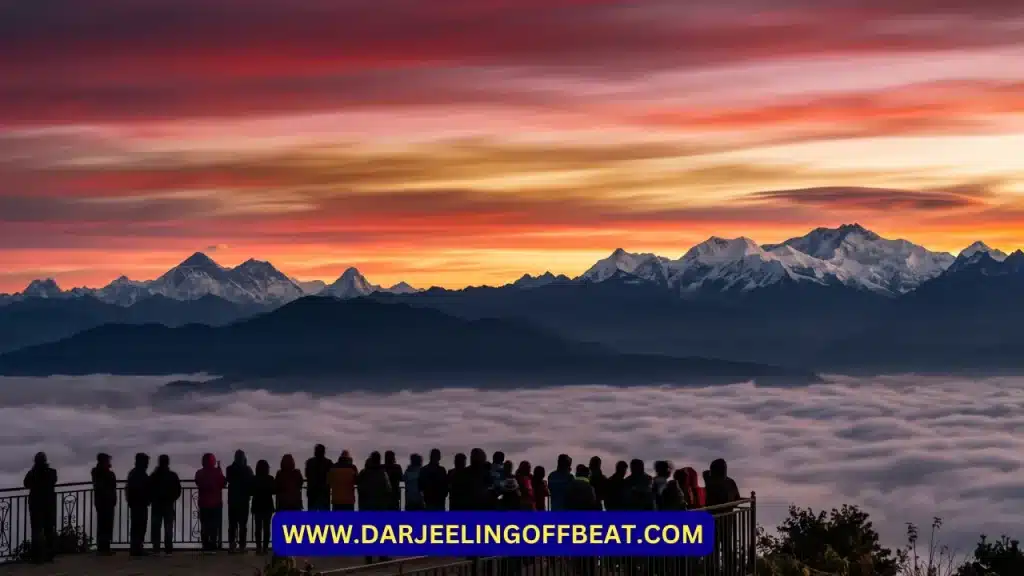
The Tiger Hill sunrise is the thing most people come to Darjeeling specifically for, and February is one of the better months to attempt it.
You’ll leave your hotel somewhere around 4 AM. The drive to Tiger Hill takes twenty to 30 minutes from the town centre. At that hour in February, the temperature is at or near its lowest — dress accordingly. Thermals, a heavy jacket, gloves, and a hat that covers your ears. The people who underpack for Tiger Hill in February remember it.
The viewpoint itself sits at around 8,482 feet. In February, the advantage over peak season is significant — instead of a jostling crowd of several hundred people competing for the front railing, you’re looking at a manageable group, space to move, room to simply stand and look without someone’s phone in your peripheral vision. For couples specifically, Tiger Hill in February has a quality of shared experience that gets diluted considerably when it’s crowded.
The light sequence, when it happens cleanly — and in Darjeeling in February it usually does — goes like this. The sky shifts from deep indigo to a pale grey before sunrise. Then the first colour arrives on the horizon, building in layers of orange and pink and finally gold as the sun clears the ridge. And then Kanchenjunga catches it. That moment — when the third-highest mountain in the world goes from grey to gold in what feels like a single breath — is the reason this place exists on every serious travel list in India. In February, with the peaks clear and sharp and the crowd manageable, it’s closer to what that experience is supposed to be than almost any other time of year.
From Tiger Hill, most people make the short stop at Ghoom Monastery on the way back. The monastery — one of the oldest in Darjeeling, housing a 15-foot Maitreya Buddha statue — is serene in the early morning, the monks’ chants carried in the cold air. It’s a good follow-up to the Tiger Hill sunrise; something contemplative after something spectacular.
Where to Stay — Heritage, Warmth & the Right Kind of Cosy

The accommodation choice in Darjeeling in February matters more than it might seem, because the right room in February doesn’t just give you a place to sleep — it becomes part of the experience.
The heritage hotels are where February makes most sense. The Windamere, established in 1841 and sitting on Observatory Hill, is the most famous. What makes it right for February specifically is the bukhari — the traditional coal-burning stove that the Windamere still maintains in its suites and cottages. These are not aesthetic props. They work. A bukhari on a February night, when the temperature outside is dropping toward single figures, produces a deep, radiating warmth that no electric heater replicates. The Windamere also, famously, has no televisions. This sounds like a deprivation until you’re sitting by the coal fire with a pot of tea and the windows frosted over and realise you haven’t thought about your phone in two hours.
The Elgin — originally the summer residence of the Maharaja of Cooch Behar — offers a slightly different version of the same essential experience. Heritage architecture, fireplaces in the common areas, mountain views from the garden, and the kind of service that comes from a property that has been doing this for well over a century. Both the Windamere and the Elgin are more accessible in February than in peak season, and the personalised attention you receive when the hotel isn’t at full capacity makes a genuine difference to the quality of the stay.
For couples specifically, ask about garden-view rooms and request a view-facing orientation when booking. The difference between waking up to a valley view and waking up to the hillside above you is considerable, Darjeeling in February, when the light on those mountains in the early morning is half the reason you came.
Mid-range boutique properties work well in Darjeeling in February, too, particularly the ones that have invested in proper heating and hot water systems. Ask specific questions before booking: what’s the heating situation, does the room have an electric blanket, is hot water available reliably in the mornings? Good properties will answer these questions directly. Properties that hedge or deflect are telling you something useful.
Getting Here from Bardhaman — The Practical Route
Most visitors travelling to Darjeeling in February from the West Bengal plains will be coming through NJP — New Jalpaiguri — which is the main rail hub for the region. From Bardhaman specifically, the Vande Bharat Express (Train 22301) leaves at 7:39 AM and arrives at NJP around 1:25 PM, making it comfortably the fastest option if you want to arrive with the afternoon still available. The Darjeeling Mail (12343) leaves Bardhaman at 11:35 PM and gets you to NJP by morning — an overnight option that works well if you want to hit the ground running.
From NJP, the mountain road to Darjeeling takes three to four hours by private taxi. February is off-season, so negotiating a reasonable rate is easier than in October. Expect to pay somewhere in the range of ₹2,500 to ₹3,500 for a private vehicle. The Hill Cart Road is the historic route — slower, more winding, more scenic. The Rohini Road is generally better surfaced and slightly faster. Ask your driver which is currently in better condition; local knowledge on this is more reliable than any app.
If you’re flying, Bagdogra Airport is the closest. Darjeeling in February doesn’t have the serious fog disruptions of January, so flight reliability is generally better, though it’s still worth building some arrival flexibility into your first day rather than planning something time-sensitive immediately after landing.
For anyone considering self-driving from Bardhaman, the total distance is around 500 km, and the journey typically takes 10 to 12 hours to Siliguri, plus the mountain ascent. The plains section has improved significantly in recent years. The Dalkhola junction can add time depending on traffic. If you’re driving, start before 6 AM and plan to be in Siliguri before the afternoon.
Losar — When February Brings the Tibetan New Year

In 2027, Losar — the Tibetan New Year — falls on February 7th, beginning the Year of the Fire Sheep. Even in years when it falls slightly outside February, Losar often touches the month’s edges, and when it does, visiting Darjeeling in February takes on an additional layer of cultural richness that most tourists completely miss.
Losar is a fifteen-day celebration, and for the Tibetan community in Darjeeling — which is significant and deeply rooted — it is the most important event of the year. The preparation begins days before the official start. On Losar Eve, families make Guthuk, a noodle soup containing nine ingredients, including dumplings that hide symbolic objects — a piece of wood, a chilli, a small stone — each of which is believed to reveal something about the year ahead for whoever finds it. The ritual is taken seriously and participated in with genuine feeling, not as a performance.
At the monasteries — Ghoom and Dali, particularly, but also Bhutia Busty — the Cham dances begin. Monks in elaborate masks and silk brocade costumes perform these ritual dances in the monastery courtyards, enacting the defeat of negative forces and the clearing of karma for the year ahead. As a visitor, you’re welcome to watch. The atmosphere is unlike anything in the more commercial festival calendar — this is a living tradition, not a staged event, and being present for it requires nothing more than respectfulness and patience.
The streets and monasteries are decorated with prayer flags and butter sculptures. Incense burns constantly. If you’re invited to share Chang (the traditional barley brew) or Kapse (fried pastries made specifically for Losar), accept. This kind of cultural access is rare and genuinely moving.
Even outside a Losar year, February’s connection to the Tibetan lunar calendar means the monasteries are active, and the community is in a particular rhythm. Visiting Ghoom Monastery or the Tibetan Refugee Self-Help Centre in February tends to feel more intimate and real than the same visit in the busy season.
The Toy Train — Darjeeling in February Is Actually the Right Time
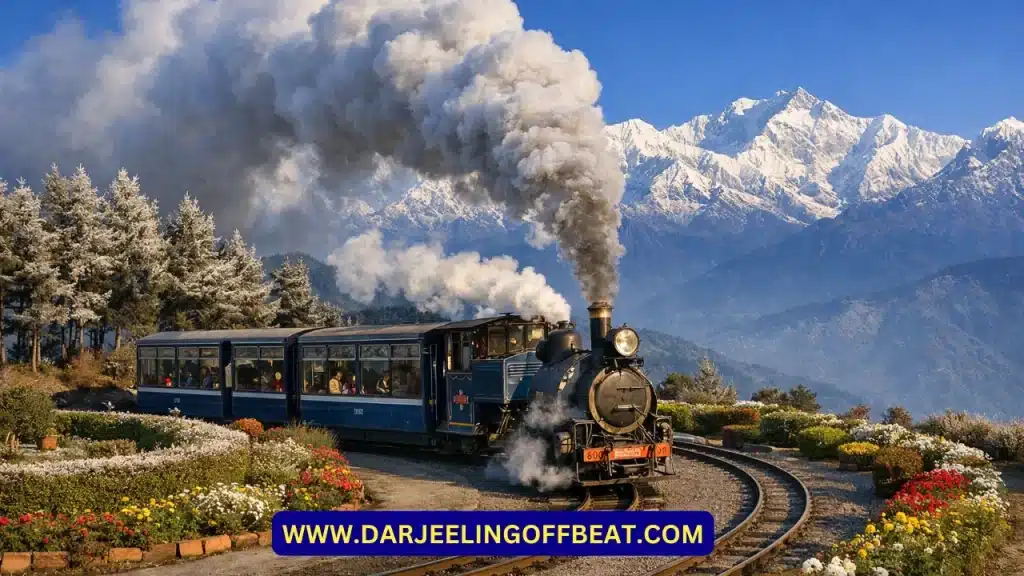
The Darjeeling Himalayan Railway — the Toy Train, as everyone calls it — operates year-round, but February is genuinely one of the better months to ride it.
The most popular option is the two-hour joyride between Darjeeling station and Ghoom. The steam version (around ₹1,400 for the round trip) is the one worth paying extra for — the coal smoke, the whistle echoing off the hillsides, the almost comically slow pace of twelve kilometres per hour through mountain villages and dormant tea gardens. Darjeeling in February, without the peak-season crowds competing for seats, booking is straightforward and the experience less rushed.
The stop at Batasia Loop — a spiral section of track engineered in the 1880s to manage a 140-foot descent — is worth lingering at. The garden here stays maintained through winter, and the view of Kanchenjunga from the loop, on a clear February morning, is one of those Darjeeling experiences that earns its reputation honestly. For couples, the Batasia Loop has a particular quality — the scale of the mountains, the slow rhythm of the train completing its curve, the cold air and the warmth of standing close to someone — that the busy season somewhat dilutes.
The full route from NJP to Darjeeling — all 88 kilometres of it, taking around seven hours — is an extraordinary journey if you have the patience for it and the right company. The Vistadome coaches, with their large windows and glass roof sections, work particularly well in February when you want the views without the cold wind.
Food — Where to Eat and What to Order

Darjeeling in February calls for food that warms you from the inside out, and the town’s culinary landscape is genuinely well-suited to exactly this.
Glenary’s on Nehru Road is the institution you go to at least once — a three-story colonial building that’s been feeding people since 1875. The ground floor bakery is where you start: pastries, good bread, the signature Darjeeling tea in a proper pot. The first-floor restaurant does continental food that’s more reliable than it sounds this far into the hills — the roast pork and the sizzlers in particular are winter-appropriate in the best way. The glass-covered balcony upstairs offers mountain views while keeping you out of the cold air. For couples, the evening here has a particular warmth to it.
Keventer’s, near Mall Road, is known for its English breakfast — bacon, eggs, sausages, toast — served on an open-air terrace that’s cold in February but bracing in the way that hill-station mornings are supposed to be. Their hot chocolate is, by general agreement among people who’ve tried both options, the best in town for a cold morning. Go for breakfast specifically.
For the most authentic local experience, Kunga Restaurant near the taxi stand is where you go for Tibetan food done properly. The pork momos are exceptional. The Beef Bhakthuk — a thick, hand-pulled noodle soup — is exactly what you want on a February evening when the temperature has dropped, and you need something substantial and warming. The space is small and unfussy and entirely without pretension, which is its own kind of charm.
Sonam’s Kitchen on Zakir Hussain Road is the breakfast alternative for people who want something lighter — pancakes, hashbrowns, good coffee, bookshelves on the wall, the atmosphere of somewhere a regular would go, rather than a tourist. February mornings here, when the place isn’t stretched by peak season volume, are genuinely lovely.
For a special evening — and February is a month that suits special evenings — the View Point Residency does rooftop candlelight dining specifically designed for couples. The valley lights below, the mountains somewhere in the darkness above, the cold air that makes sitting close feel natural rather than staged. It’s the kind of setting that does the work for you.
Darjeeling tea, throughout all of this, is the constant. The gardens are still dormant in February — the first flush doesn’t begin until late February or early March — but last season’s teas are available at every serious tea room and boutique in town. Nathmulls on the Mall is where the knowledgeable buyers go. The Windamere tea service is the ceremonial experience. Happy Valley Tea Estate, walkable from the town centre, offers factory tours and informal tastings that give you a sense of the process even when the garden is in its pruning and preparation phase.
The Offbeat Options — Beyond the Town Centre
If you’ve been to Darjeeling in February before, or if you want the town to be part of the trip rather than all of it, February opens up several day-trip possibilities that the season suits particularly well.
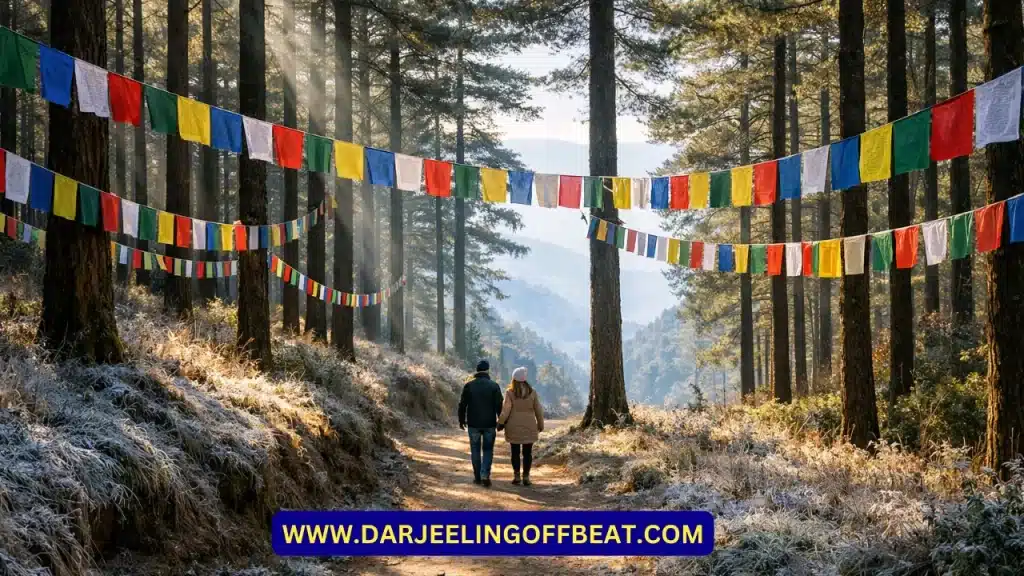
Lamahatta, about 23 kilometres from Darjeeling, is a small eco-park and village that most visitors skip entirely. In February, with the pine forests clear and the sky doing its winter thing, the watchtower at Lamahatta offers views of the Teesta River valley and Kanchenjunga that are less crowded and in some ways more intimate than Tiger Hill. The walk through the forest paths here — prayer flags strung between the pines, the ground cold and firm underfoot — has a quality of genuine quietness that’s harder to find in the town centre even in off-season.
Lepcha Jagat, 19 kilometres from Darjeeling at around 2,100 metres, is a forest village with almost no tourist infrastructure, which is precisely the point. In February, the forest is still and cold, and the sunsets from the ridge are extraordinary. The WBFDC bungalow here is bookable in advance, and sleeping in a forest bungalow on a February night, with the valley far below and the cold pressing against the windows, is one of those travel experiences that costs almost nothing and stays with you for years.
Sittong, further out at about 35 kilometres, carries its orange orchards into February — the mandarin season extends through January and into the early part of the month. By late February, the season is ending, so go earlier rather than later if the orange orchards are part of the appeal. The stargazing at Sittong in February is extraordinary — no light pollution, cold air that’s settled and clear, a sky that rewards the patience of staying outside long enough for your eyes to adjust.
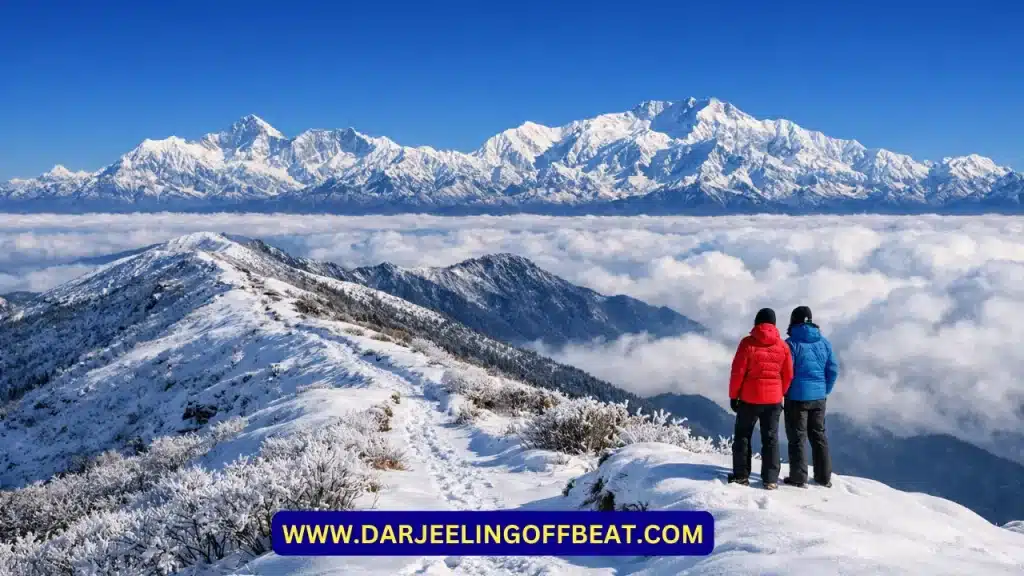
For adventurous couples, Sandakphu in February deserves serious consideration. The ridge sits at 3,636 metres, and in February it frequently carries snow — not the deep mid-winter accumulation of January, but enough for the landscape to feel properly alpine. The four-peak panorama from the summit — Everest, Kanchenjunga, Lhotse, Makalu simultaneously — is available here in February with good clarity probability. Access is via jeep from Manebhanjan. Pack for a serious cold at the top — down jacket, thermal layers, insulated everything.
The Tea Gardens in February — Dormancy and What It Teaches You
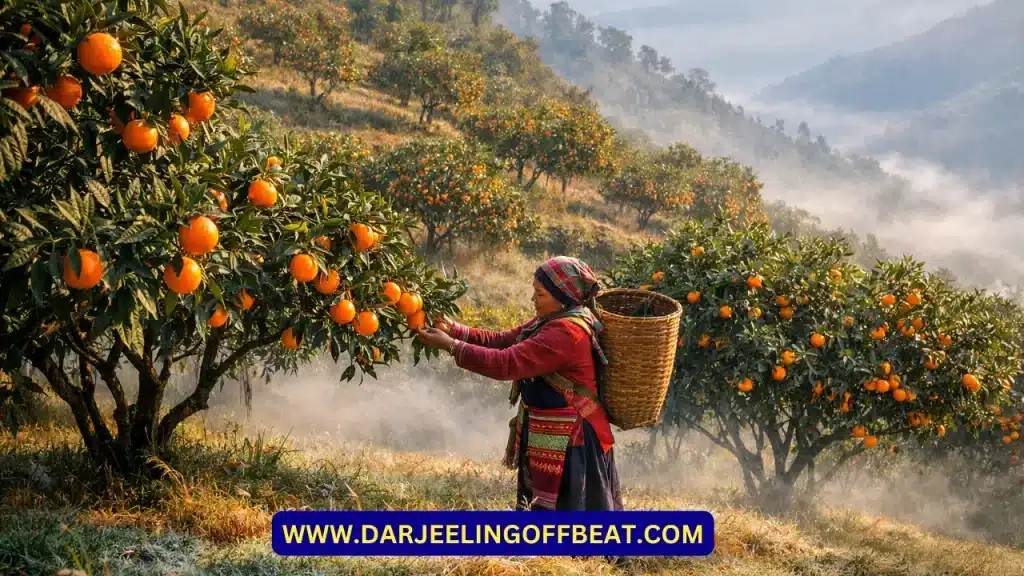
The Darjeeling tea gardens are in their dormant phase for most of February. No plucking is happening, or very little — the first flush, the year’s most prized and delicate harvest, begins to stir only in the very last days of the month as the temperature starts its slow climb toward spring.
This dormancy is, counterintuitively, one of the more interesting times to visit a garden. Happy Valley, the estate closest to town, offers tours year-round and in February, the focus shifts to what happens between harvests — the pruning of the bushes, the preparation of the soil, the maintenance of the factory equipment. The garden workers are less rushed than during harvest, the guides have more time, and the tours feel more like actual conversations than managed experiences.
For the most immersive tea experience, staying at a tea bungalow is the February option that particularly rewards the right kind of traveller. Glenburn Tea Estate, on the banks of the Teesta River, offers accommodation in a heritage planter’s bungalow with guided tastings and garden walks included. In February, without the harvest activity, the estate has a particular kind of stillness — the ordered rows of pruned bushes, the mist in the valley below, the planter’s bungalow warm against the cold evening. It’s unhurried in a way that the busy months simply aren’t.
Makaibari, one of the most famous estates in the world, runs similar bungalow stays with an emphasis on the organic farming methods and biodynamic practices that have made their tea internationally sought-after. A February morning tasting of fifteen or more estate teas — the guide walking you through the seasonal character of each, the difference between first and second flush, the particular quality of a muscatel — is the kind of experience that changes how you think about tea permanently.
Practical Notes for Darjeeling in February
A few things worth knowing specifically for Darjeeling in February that don’t always make it into the standard guides.
Book hotels in advance even though it’s off-season. The best rooms at the Windamere and the Elgin — particularly the ones with mountain views and working fireplaces — are limited in number and still get taken. A week’s advance notice is usually sufficient, but two weeks is safer, and if you’re planning around Valentine’s week specifically, book earlier.
Valentine’s week sees a modest uptick in visitors. Not peak-season levels, nothing overwhelming — but enough that the better restaurants get busier than usual around the 14th, and some of the romantic packages at the heritage hotels fill up. If you’re travelling specifically for Valentine’s Day, account for this with a little extra planning.
Cash is useful to carry. ATMs in Darjeeling work reliably for the most part in February, but the Bhutia Market stalls, smaller local restaurants, and some of the offbeat homestays around Lamahatta and Sittong prefer or require cash. Having ₹5,000 or so on hand at the start of the trip saves potential inconvenience.
Motion sickness medicine before the mountain road ascent — Avomine is the one most travellers in this region recommend, taken the night before rather than on the morning of the drive. The hairpin turns on the Hill Cart Road or the Rohini Road affect people unpredictably, and discovering you’re susceptible four hours in is avoidable.
The early morning cold at Tiger Hill in February is serious. This cannot be overstated enough to people who haven’t experienced it. Four layers minimum. Gloves that cover your wrists. A hat that covers your ears. A flask of something hot. The people who show up to Tiger Hill in February in a light jacket and no gloves are the ones who retreat to the vehicle after fifteen minutes and miss the best part of the sunrise.
Why Darjeeling in February Is the Right Month for Couples

There’s something about Darjeeling in February that suits couples specifically, beyond just the obvious Valentine’s Day angle.
It’s the combination of factors, really. The cold that makes closeness feel practical. The quietness that makes conversation possible without the ambient noise of a busy tourist town. The quality of the light on the mountains in the morning, which affects people, it makes them stop, really stop, and look at something together. The heritage hotels with their fires and their unhurried service. The long evenings encourage staying in one good restaurant for two hours rather than rushing through a packed itinerary.
Darjeeling in February doesn’t need to perform for you. It doesn’t need to be dressed up or marketed. It’s just there, cold and clear and genuinely beautiful, with the mountains visible from more angles and more moments than any other month offers. Darjeeling in February has a quality of belonging to itself rather than to the tourist season — and that, more than any romantic package or candlelight dinner, is what makes it special for couples.
Go in February. Stay in a heritage hotel with a working fire. Get up early for Tiger Hill even though it’s cold. Eat momos at Kunga. Ride the toy train slowly through the dormant tea gardens. Stand at Batasia Loop and look at Kanchenjunga until you run out of things to say about it.
That’s what Darjeeling in February is. And it’s enough.
Have you visited Darjeeling in February? Share what you found — the clear mornings, the cold, the unexpected moments. Real traveller stories are always the most useful part of any guide.
FAQ
Q.1: Is February a good time to visit Darjeeling?
Ans: Yes, Darjeeling in February is one of the most underrated months to visit Darjeeling. Skies are clear approximately 80 per cent of the time, Kanchenjunga views are sharp and stunning, crowds are thin, hotel rates are lower than peak season, and the town has a genuine quietness that April and October simply cannot offer. For couples, especially, February is arguably the best month of the year.
Q.2: How cold is Darjeeling in February?
Ans: Darjeeling in February is cold but more manageable than January. Daytime temperatures range between 12°C and 15°C — comfortable for sightseeing in good layers. Nights drop to 2°C–8°C. Early mornings at Tiger Hill still require thermals, a heavy windproof jacket, gloves, and an ear-covering hat. Afternoons in the sunshine feel genuinely pleasant with a good fleece.
Q.3: Is Darjeeling good for couples and honeymoon in February?
Ans: Absolutely. Darjeeling in February is widely considered the most romantic month. The combination of clear mountain views, thin crowds, heritage hotels with coal bukharis and fireplaces, candlelight rooftop dining, and the quiet, unhurried pace of an off-season hill town creates a naturally intimate atmosphere. Heritage properties like the Windamere and the Elgin are particularly well-suited for couples during this month.
Q.4: Can you see Kanchenjunga clearly from Darjeeling in February?
Ans: Yes — Darjeeling in February offers some of the clearest mountain visibility of the entire year. With humidity averaging just 44 per cent and minimal cloud cover, Kanchenjunga appears razor sharp and extraordinarily close. On clear mornings from Tiger Hill, Lhotse, and Makalu are also visible on the horizon — four of the world’s five highest peaks simultaneously. Visibility success rate at Tiger Hill in February is approximately 80 per cent.
Q.5: What is the best hotel to stay in Darjeeling in February?
Ans: The Windamere Hotel — established in 1841 — is the top choice for February specifically because of its traditional coal-burning bukharis that provide deep, genuine warmth on cold winter nights. No televisions, period antiques, personalised service, and mountain views make it ideal for couples. The Elgin is an excellent alternative with heritage fireplaces and garden views. Book both well in advance, even in the off-season, as the best rooms fill quickly.
Q.6: What festivals happen in Darjeeling in February?
Ans: Losar — the Tibetan New Year — sometimes falls in February depending on the lunar calendar. In 2027, it falls on February 7th. It is a 15-day celebration featuring spectacular Cham masked dances at Ghoom and Dali monasteries, family rituals including the traditional Guthuk noodle soup, street decorations with prayer flags and butter sculptures, and the sharing of Chang and Kapse pastries with visitors. Even outside a Losar year, Darjeeling’s monasteries are particularly active and accessible in February.
Q.7: What should I eat in Darjeeling in February?
Ans: Start with Thukpa — Tibetan noodle soup that is the essential winter dish, available at Kunga Restaurant near the taxi stand. Steamed momos with hot Dalle chilli achar are perfect street food. Glenary’s on Nehru Road is essential for bakery breakfasts and the glass-covered balcony restaurant. Keventer’s is the top choice for English breakfast and the best hot chocolate in town. For a special evening, the View Point Residency does rooftop candlelight dinners with valley views.
Q.8: How do I reach Darjeeling from Bardhaman in February?
Ans: The fastest option is the Vande Bharat Express (Train 22301) departing Bardhaman at 7:39 AM, arriving NJP around 1:25 PM — taking approximately 5 hours 46 minutes. The Darjeeling Mail (12343) departs at 11:35 PM for a comfortable overnight journey, arriving by morning. From NJP, hire a private taxi to Darjeeling for ₹2,500–₹3,500 — a further 3 to 4 hours on the mountain road via Hill Cart Road or the better-surfaced Rohini Road.
Q.9: Is the Darjeeling toy train running in February?
Ans: Yes, the Darjeeling Himalayan Railway operates fully throughout February. The 2-hour steam joyride between Darjeeling and Ghoom costs approximately ₹1,400 and is significantly more enjoyable in February than in peak season because seats are available without weeks of booking and the viewpoints — particularly Batasia Loop — are uncrowded. The Kanchenjunga view from the Batasia Loop on a clear February morning is genuinely extraordinary.
Q.10: What are the best offbeat places to visit near Darjeeling in February?
Ans: Three offbeat destinations work particularly well in February. Lamahatta Eco Park — 23 km from Darjeeling — offers pine forest walks and uncrowded valley views. Lepcha Jagat — 19 km away — is a quiet forest village with outstanding sunsets and WBFDC bungalow accommodation. Sittong — 35 km away — still carries its orange orchards into early February and offers exceptional stargazing. For adventurous couples, Sandakphu (58 km) in February delivers possible snow cover and the iconic four-peak Himalayan panorama. 🏔️
- Kashyem Kaman Kalimpong Teesta Rangpo Confluence View 2026: The Cedar Ridge
 Kashyem Kaman Kalimpong Teesta Rangpo confluence view — Teesta-Rangpo confluence below and Kanchenjunga above — plus Cinchona heritage trails and cedar forest homestays at ₹1,250/day. There is a specific kind of view that requires exactly the right elevation — too high and the cloud covers everything, too low and the angle is wrong. Kashyem Kaman …
 - Kalijhora Homestay & Teesta Travel Guide: How a Picnic Spot Turned Into North Bengal’s Quietest Adventure Hub
 Kalijhora homestay guide: where to stay near the Teesta, rafting routes & prices, Panboo ridge views, and everything to plan your North Bengal trip If you’ve driven up NH10 from Siliguri toward Kalimpong or Darjeeling, you’ve passed through Kalijhora without necessarily noticing it. That’s kind of the point. It sits about 28 kilometres north of …
 - Goiri Gaon, Kalimpong: The Village the Forest Kept Secret — Now With the Full Story
 Goiri Gaon Kalimpong Neora Valley offbeat — red panda corridor, Maria Busty 1891 church, Pedong Silk Route ruins, and homestay-only model. Complete offbeat guide inside. There are places in the Eastern Himalayas that exist in a kind of geographical grace — tucked far enough from the main roads that the noise of modern hill tourism …
 - Gitkolbong Village Kalimpong: The Village That Climbs From River to Ridge
 Gitkolbong village Kalimpong near Lava, with tea plantations, the Gitkhola river, and a ridge trail to Gitkolbong Top with Kanchenjunga views. Complete offbeat travel guide inside. Some places reveal themselves slowly. You arrive, and the first impression is modest — a quiet mountain village, some terraced farmland, a stream you can hear before you see …
 - Daragaon Kalimpong Kanchenjunga View Where the Clouds Stay Below You
 Daragaon Kalimpong Kanchenjunga view— offers a rare sea-of-clouds sunrise view with the world’s third-highest peak floating above the Teesta valley. Complete travel guide inside. There’s a moment that happens at Daragaon — usually around six in the morning, usually in October or November — that people struggle to describe accurately afterwards. You’re standing at the …
 - Dalapchand Silk Route Kalimpong: Where West Bengal Meets Sikkim
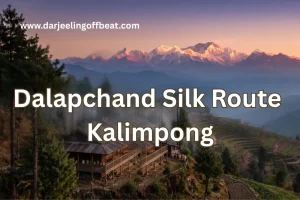 Some destinations, like Dalapchand Silk Route Kalimpong, exist because someone put them on a map, and others exist because the landscape demanded them. Dalapchand is the second kind. Sitting right on the border zone between Kalimpong district in West Bengal and Pakyong district in East Sikkim, this quiet mountain hamlet occupies a genuinely rare position. …






North Bengal's offbeat magic is my muse. I find adventure in whispering waterfalls, vibrant village life, and breathtaking Himalayan vistas. Join me as I delve deeper, seeking stories and experiences beyond the mainstream, from Darjeeling's tea havens to the unexplored corners of this incredible region