
There’s a particular kind of traveller who plans a trip around a bird. Who wakes before the alarm, walks quietly into the forest before dawn, and stands absolutely still for twenty minutes because something small and extraordinary might appear in the canopy above. If you know this feeling — or suspect you might — then Chuikhim is a name you need to know.
But here’s the thing about Chuikhim: it isn’t only for birders. It happens to be one of the most ecologically extraordinary locations in the Kalimpong hills, and the reasons it draws serious ornithologists are the same reasons it rewards anyone who pays attention to landscape. The forest is dense and intact. The rivers are active and wild.
The altitude shifts dramatically over a short distance, producing the kind of biodiversity that occurs only in genuine transition zones. And the village itself sits right in the middle of all of it — on a southern ridge of Kalimpong district, between the subtropical plains and the temperate Himalayan forests, between one ecological world and another.
That position — literally between two biomes — is what makes Chuikhim special, and what makes the birding here some of the finest in West Bengal.
Where Chuikhim Birding Kalimpong Is and What the Landscape Looks Like
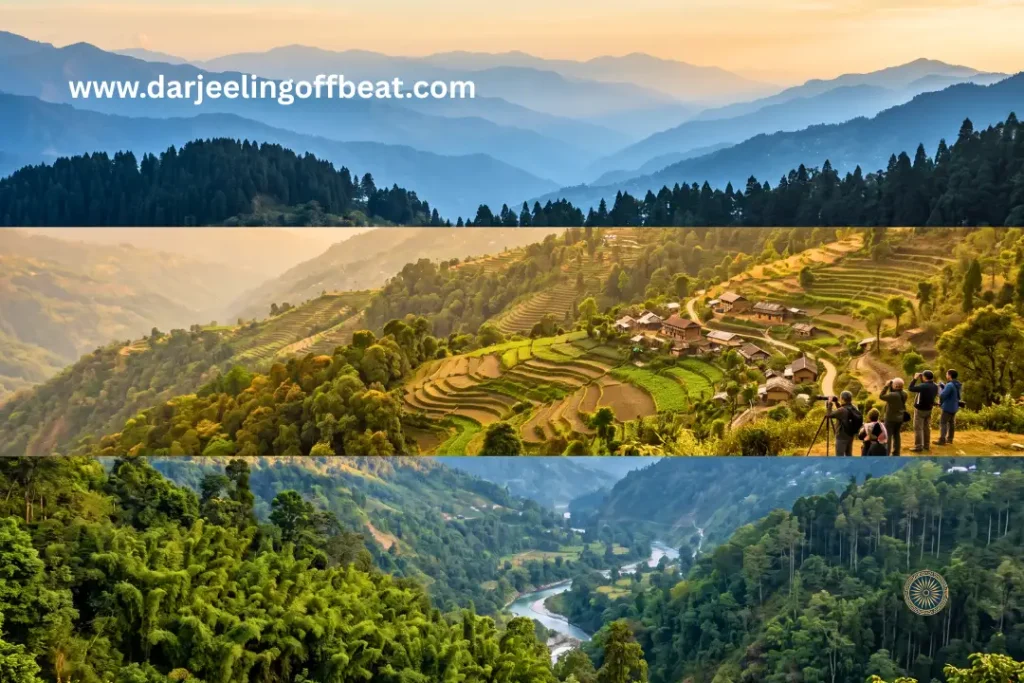
Chuikhim occupies a southern ridgeline in Kalimpong district, sitting at an elevation that ranges from 3,500 feet at its lower reaches to 5,000 feet along its upper forest edges. That 1,500-foot range within a single location already tells you something important: this is not a flat, uniform landscape. It tilts, drops, rises, and changes character as you move through it.
Geomorphologically, Chuikhim sits at the meeting point of the sub-tropical plains of the Western Dooars and the temperate broadleaf and coniferous forests of the Eastern Himalayas. The terrain rolls and terraces — agricultural slopes, secondary pine plantations, deep river gorges carved by active mountain streams. Visually, it has that quality of a landscape that’s still being made, still shifting between identities.
From NJP (New Jalpaiguri): Approximately 75–80 kilometres, making it a comfortable 2 to 2.5-hour drive through the Teesta valley and into the Kalimpong hills.
From Bagdogra Airport: Around 80–85 kilometres.
From Kalimpong town: Roughly 20–25 kilometres, descending from the main market area toward the southern ridgeline via forest roads that open up occasional spectacular valley views on the way down.
The approach to Chuikhim village Kalimpong is itself a gradual introduction to the landscape. You descend from Kalimpong’s higher reaches, the vegetation changes around you, and by the time you arrive you’ve already passed through three or four distinct ecological registers without quite noticing.
The Rivers — Four Watercourses That Define Everything
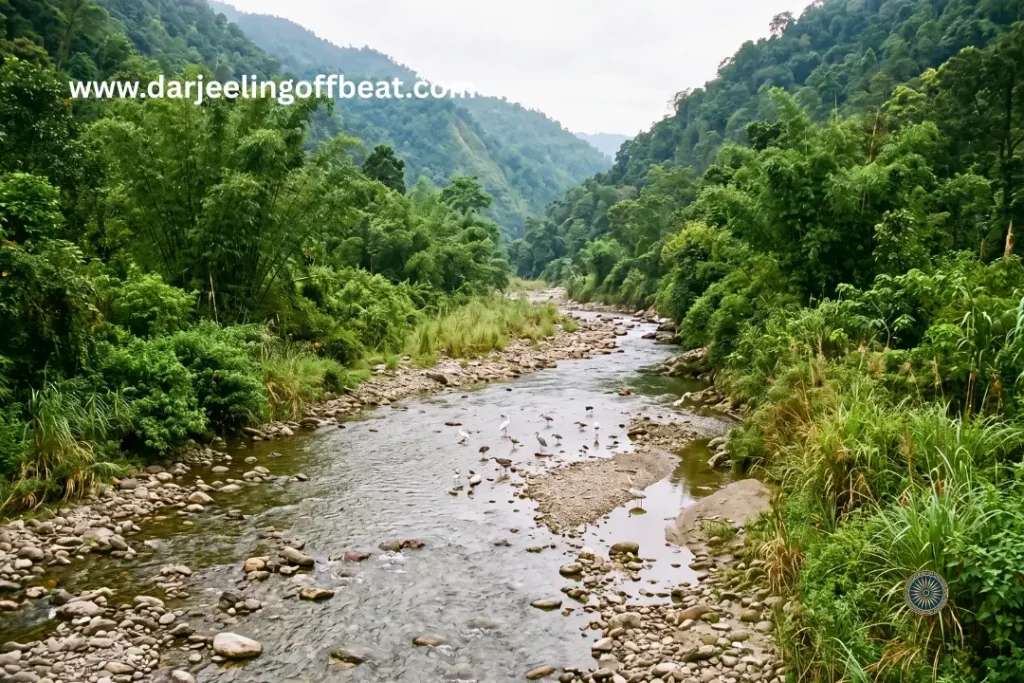
Understanding Chuikhim birding Kalimpong means understanding its rivers. Four major watercourses shape the ecology, the birding, and the fundamental character of this landscape, and each one is distinct.
The Leesh Chu — The Canyon of Kalimpong
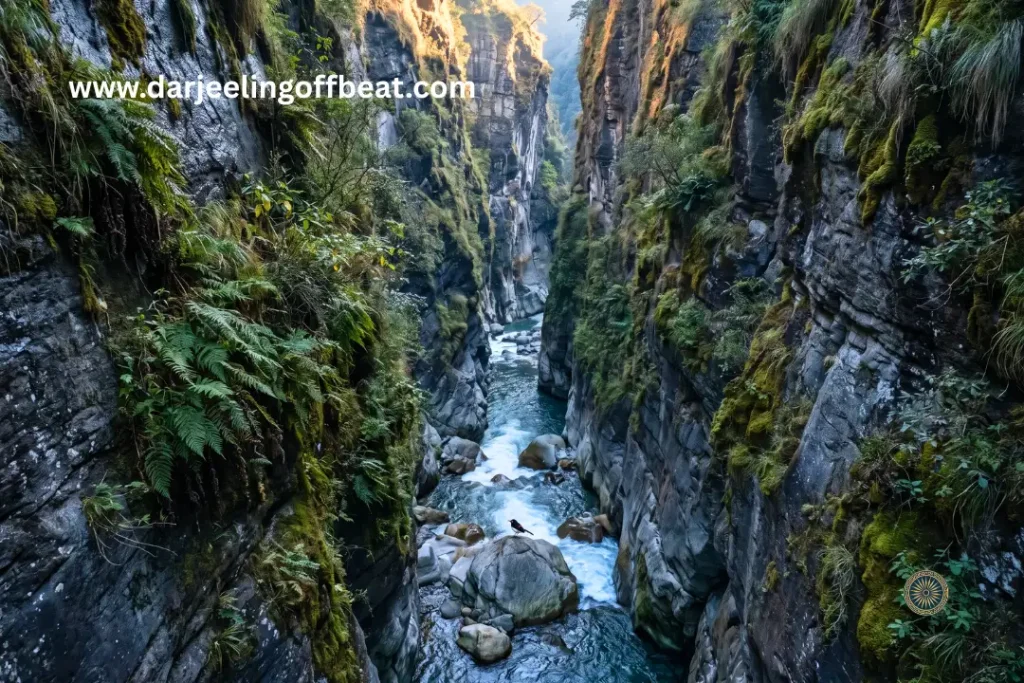
Directly west of the Chuikhim birding Kalimpong ridge, the Leesh Chu (Leesh River) has carved itself through steep limestone into what local geography calls the canyon of Kalimpong — a cliff-bound gorge system that is, by any standard, a remarkable natural feature. The riverbed here sits at around 1,200 feet, nearly 3,800 feet below the upper ridgelines of the circuit.
That vertical drop within such a short horizontal distance creates a localised microclimate in the gorge bottom that supports species simply not found anywhere higher in the hills.
The limestone canyon walls themselves host specialised flora and nesting bird communities that are gorge-specific — species that breed in cliff faces, forage along fast-moving rocky rivers, and exist in conditions that don’t occur anywhere else in the immediate region.
The Ghish and Chel Rivers
To the south and east, the Ghish and Chel river basins function as something crucial in ecological terms: migration corridors. These riverine channels connect the forested foothills near Bagrakote to the high-elevation ecological zones of Charkhole, Loleygaon, and Neora Valley National Park.
During seasonal bird migration, species move along these corridors in both directions — lowland species pushing upward in spring, high-altitude species descending in winter. Chuikhim village Kalimpong sits at a point where these movements pass through and linger.
The Reshi River
The Reshi completes the hydrographic network, adding another riverine habitat dimension to the circuit. Multiple river systems within a confined geographical area means multiple habitat types within walking or short driving distance — a birder’s dream configuration.
The Altitudinal Gradient — Why This Matters So Much
The full Chuikhim birding Kalimpong circuit spans from approximately 1,200 feet at the Leesh Chu riverbed to over 5,500 feet along the upper forest ridgelines of Charkhole and Loleygaon. That’s a 4,300-foot elevation shift accessible within a single birding circuit — and in ecological terms, that’s extraordinary.
At the lowest elevations, around the river gorge and foothills near Bagrakote, the vegetation is sub-tropical: bamboo groves, riverine scrub, sal thickets. These habitats support lowland and plains-edge species that wouldn’t survive at higher altitudes — species more typical of the Dooars than the Himalayan hills.
Move upward into the mid-altitude zone and the forest shifts into mixed broadleaf — oak, birch, and alder forming a dense canopy over a rich understorey. This is prime habitat for the mid-elevation Himalayan species that most birders specifically target when visiting this region.
Higher still, along the upper ridgelines near Charkhole and Loleygaon, sub-alpine pine stands create a third distinct habitat layer with its own specialist community.
Three completely different ecosystems, all accessible within a single circuit based from Chuikhim birding Kalimpong village. This altitudinal stacking is the fundamental reason serious birders come here specifically rather than to other parts of the Kalimpong hills.
Chuikhim village Kalimpong — What You’re Actually Looking For
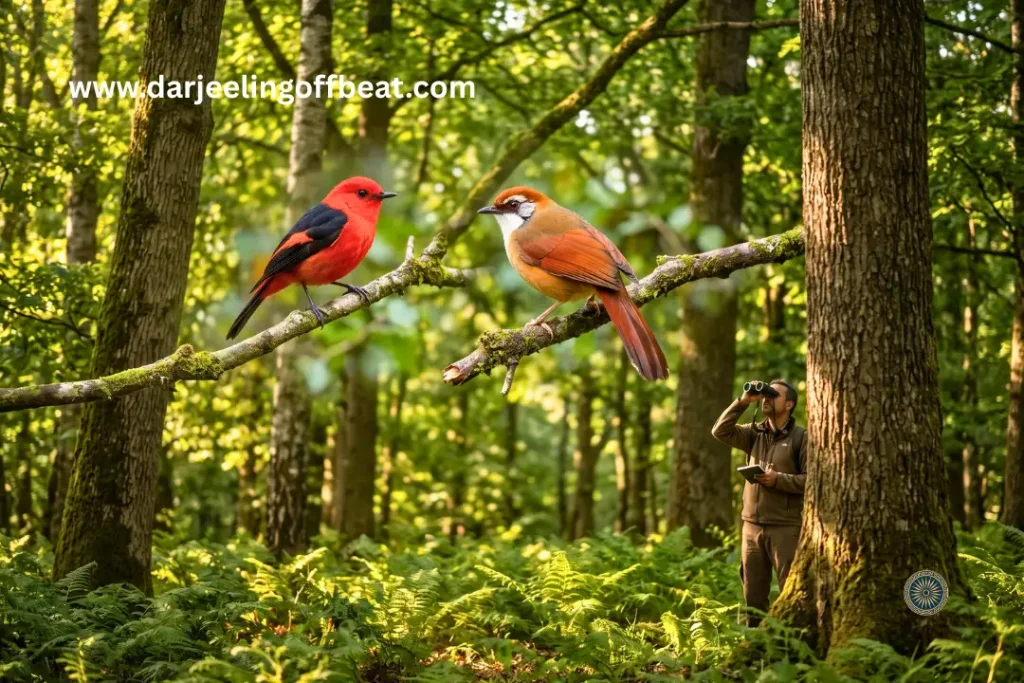
It would be misleading to give a definitive species list here, because the Chuikhim village Kalimpong circuit’s seasonal variation is wide and what you encounter depends heavily on when you come. But the habitat profile tells you the categories to expect.
The limestone gorge of the Leesh Chu is the place for riverine specialists — species that hunt along fast-moving rocky streams and nest in cliff faces. Forktails, dippers, and similar river-adapted birds are gorge-floor regulars.
The bamboo groves and riverine scrub of the lower elevations hold Dooars-edge species that push up from the plains — creating an overlap zone where subtropical and Himalayan species share the same few acres of habitat, sometimes uncomfortably close to each other.
The mixed broadleaf mid-altitude forest is where the Chuikhim circuit builds its reputation. This is classic Eastern Himalayan birding territory: laughingthrushes, babblers, warblers during migration, flycatchers of several families, minivets, sunbirds, and a rotation of species across the seasons that keeps the list moving and unpredictable.
The migration corridors along the Ghish and Chel rivers mean that passage migrants — species moving through rather than residing — add a layer of seasonal unpredictability that experienced birders find particularly compelling. You never quite know what might be moving through.
The upper pine-and-broadleaf zone connects to Neora Valley’s biodiversity, giving the circuit access to higher-altitude specialists without requiring a full relocation to a different base.
For non-birders reading this: that range of habitat and species diversity, compressed into a single accessible circuit, is genuinely unusual. Most places in India offer one or two habitat types at a birding destination. Chuikhim village Kalimpong offers five.
The Chuikhim village Kalimpong Itself
Chuikhim birding Kalimpong is a quiet, working village — not a birding resort, not a curated eco-tourism showcase. The landscape of rolling terrain, terraced agricultural slopes, and secondary pine plantation means the village integrates naturally into the forest edge rather than sitting apart from it.
Homestay accommodation here puts you directly inside that landscape. Your morning starts in the forest. Your breakfast is produced within walking distance. The people who live here have watched this forest across generations and know it in ways no field guide can replicate — a good local guide from the village is worth more than any app for finding species in this specific terrain.
The pace of life in Chuikhim is structured around agriculture and the natural rhythms of the forest. Early mornings are active — birdsong begins before light and peaks in the first two hours after dawn. Afternoons slow down.
Late afternoon brings a second activity window before dusk. In between, there’s forest to walk, rivers to sit beside, and the particular pleasure of a landscape that hasn’t been managed for tourist convenience.
The Broader Circuit — Charkhole, Loleygaon, and Neora Valley
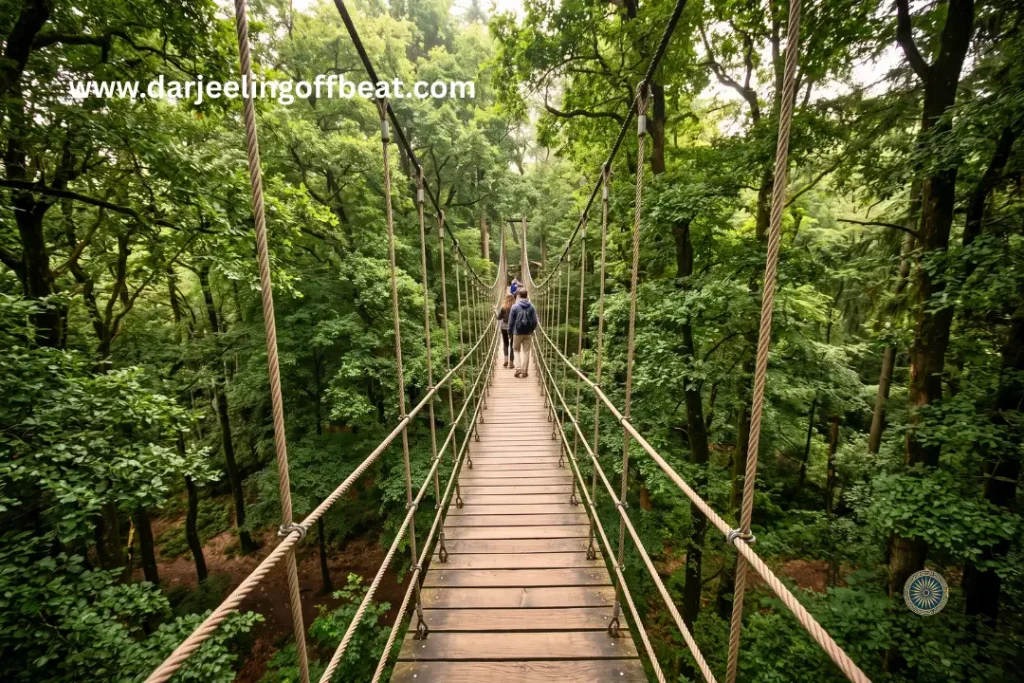
Chuikhim works best as the central node of a multi-destination circuit across the eastern Kalimpong hills. The connections are natural, and the itinerary builds itself.
Charkhole sits on the upper ridgeline above Chuikhim — a small forest village at higher elevation that adds montane species to the circuit and provides dramatic valley views back toward the plains.
Loleygaon (Kafer) is one of the better-known offbeat destinations in this part of West Bengal, sitting within the same ecological corridor. Its established canopy walkway through the forest is a genuine attraction, and the birding from the treetop level adds a perspective that ground-based observation can’t replicate.
Neora Valley National Park, the strictly protected wilderness that anchors the entire regional ecosystem, is the natural endpoint of a circuit that starts at Chuikhim’s lower gorge and climbs through the forest to the national park boundary. A proper multi-day itinerary — descending from Neora Valley through Loleygaon and Charkhole to Chuikhim and then out toward Bagrakote — covers the full altitudinal gradient and remains one of the most ecologically varied routes available in the Eastern Himalayan foothills.
Bagrakote at the lower end of the circuit provides the plains-edge habitat that completes the altitudinal picture.
When to Visit
November to February — Winter Birding
Winter brings species down from higher elevations as temperatures push them into the mid-altitude zones. Atmospheric clarity is excellent, vegetation is less dense, making sighting easier, and the Leesh Chu gorge is at its most accessible. Cold nights require proper gear, but daytime birding conditions are often perfect.
March to May — Migration and Breeding
Spring migration pushes species upward through the Ghish and Chel corridors, producing the passage migrant diversity that makes this circuit unpredictable and exciting. Resident species begin breeding activity, making them more visible and behaviourally interesting. The forest is increasingly lush through April and May.
September to October — Post-Monsoon
The forest is at maximum green intensity just after the monsoon. Visibility improves rapidly through September, and by October conditions are excellent. A good second window for migration species moving in the opposite direction as the season cools.
June to August — Monsoon
Leeches. Difficult roads. Low visibility. That said, the breeding activity of resident species peaks during monsoon, and the forest is extraordinary in its green intensity. For experienced birders comfortable with difficult conditions, the monsoon has its rewards. For everyone else, come in another season.
Practical Notes for Chuikhim village Kalimpong
A local guide is strongly recommended — not optional. The circuit covers multiple habitat types across significant altitude changes, and having someone who knows where species concentrate in each season dramatically changes the quality of the experience.
Binoculars minimum 8×42. A field guide to birds of the Eastern Himalayas. Waterproof footwear for the gorge approach. Layers for the altitude shift between the river bottom and the upper ridgelines.
Start birding before sunrise. The Leesh Chu gorge in the pre-dawn half-light, with the river sound below and the forest beginning to wake above, is one of those experiences that people who’ve done it tend to describe in an almost embarrassed way because the language doesn’t quite work. Go early.
Why Chuikhim village Kalimpong Deserves More Attention Than It Gets
The Eastern Himalayan foothills of West Bengal are, by any ecological measure, one of the most biodiverse regions in South Asia. The birding here is world-class — the kind that appears in specialist travel publications targeting serious ornithologists from Europe and North America. But within that region, most of the tourist attention concentrates on the same three or four destinations.
Chuikhim is not one of those destinations yet. The infrastructure is modest, the name is not widely recognised, and it doesn’t have a famous viewpoint or a heritage building to anchor a general travel narrative. What it has instead is a limestone canyon, four river systems, a 4,300-foot altitudinal gradient, forest that connects directly to Neora Valley, and a location precisely at the meeting point of the subtropical plains and the temperate Himalayan forest.
In ecological terms, that’s as good as it gets in this part of India. The birding world knows it. It’s time the wider travel community caught up.
Elevation range: 3,500–5,000 ft (village) | Full circuit: 1,200–5,500+ ft
District: Kalimpong, West Bengal
From NJP: ~75–80 km | From Bagdogra: ~80–85 km | From Kalimpong town: ~20–25 km
Key rivers: Leesh Chu, Ghish, Chel, Reshi
Ecological highlight: Sub-tropical to temperate transition zone; Neora Valley corridor
Best seasons: November–February and March–May
Circuit connections: Charkhole, Loleygaon, Neora Valley, Bagrakote
Don’t miss: Leesh Chu gorge at dawn, mid-altitude oak forest birding, migration window March–April
In the above blog post we covered Chuikhim birding Kalimpong, Chuikhim village Kalimpong,
birdwatching Kalimpong hills, Leesh River canyon Kalimpong, offbeat birding West Bengal, Kalimpong birding circuit, Charkhole Loleygaon birding, Neora Valley birding trail, Eastern Himalayan birding, Ghish River birding corridor, offbeat places near Kalimpong, Chuikhim homestay, birdwatching North Bengal, Kalimpong ecotourism, Bagrakote birding West Bengal, Reshi River Kalimpong, subtropical Himalayan transition zone, Kalimpong district wildlife, offbeat North Bengal tourism, bird migration Eastern Himalayas
- Kashyem Kaman Kalimpong Teesta Rangpo Confluence View 2026: The Cedar Ridge
 Kashyem Kaman Kalimpong Teesta Rangpo confluence view — Teesta-Rangpo confluence below and Kanchenjunga above — plus Cinchona heritage trails and cedar forest homestays at ₹1,250/day. There is a specific kind of view that requires exactly the right elevation — too high and the cloud covers everything, too low and the angle is wrong. Kashyem Kaman …
 - Kalijhora Homestay & Teesta Travel Guide: How a Picnic Spot Turned Into North Bengal’s Quietest Adventure HubKalijhora homestay guide: where to stay near the Teesta, rafting routes & prices, Panboo ridge views, and everything to plan your North Bengal trip If you’ve driven up NH10 from Siliguri toward Kalimpong or Darjeeling, you’ve passed through Kalijhora without necessarily noticing it. That’s kind of the point. It sits about 28 kilometres north of …
- Goiri Gaon, Kalimpong: The Village the Forest Kept Secret — Now With the Full StoryGoiri Gaon Kalimpong Neora Valley offbeat — red panda corridor, Maria Busty 1891 church, Pedong Silk Route ruins, and homestay-only model. Complete offbeat guide inside. There are places in the Eastern Himalayas that exist in a kind of geographical grace — tucked far enough from the main roads that the noise of modern hill tourism …
- Gitkolbong Village Kalimpong: The Village That Climbs From River to RidgeGitkolbong village Kalimpong near Lava, with tea plantations, the Gitkhola river, and a ridge trail to Gitkolbong Top with Kanchenjunga views. Complete offbeat travel guide inside. Some places reveal themselves slowly. You arrive, and the first impression is modest — a quiet mountain village, some terraced farmland, a stream you can hear before you see …
- Daragaon Kalimpong Kanchenjunga View Where the Clouds Stay Below YouDaragaon Kalimpong Kanchenjunga view— offers a rare sea-of-clouds sunrise view with the world’s third-highest peak floating above the Teesta valley. Complete travel guide inside. There’s a moment that happens at Daragaon — usually around six in the morning, usually in October or November — that people struggle to describe accurately afterwards. You’re standing at the …
- Dalapchand Silk Route Kalimpong: Where West Bengal Meets SikkimSome destinations, like Dalapchand Silk Route Kalimpong, exist because someone put them on a map, and others exist because the landscape demanded them. Dalapchand is the second kind. Sitting right on the border zone between Kalimpong district in West Bengal and Pakyong district in East Sikkim, this quiet mountain hamlet occupies a genuinely rare position. …
- Chuikhim birding Kalimpong: That Sits Between Two WorldsThere’s a particular kind of traveller who plans a trip around a bird. Who wakes before the alarm, walks quietly into the forest before dawn, and stands absolutely still for twenty minutes because something small and extraordinary might appear in the canopy above. If you know this feeling — or suspect you might — then …
- Chisang Village Kalimpong: Where India Ends and Bhutan BeginsThere’s something quietly extraordinary about standing at the edge of a country and not at an airport or a formal border crossing, but on a hillside at dusk, looking across a valley into another nation’s lights. No fence in sight, no checkpoint, just a ridge and a silence and the slow understanding that the world …
- Bidyang Village, Kalimpong: A Riverside Escape You Didn’t Know You NeededSome places earn their reputation through grandeur — towering peaks, famous monasteries, names that appear on every travel list. And then there are places like Bidyang Kalimpong, which earn theirs more quietly. The sound of a river running over stones. The smell of cardamom on a warm afternoon. A valley so tucked away from the …









North Bengal's offbeat magic is my muse. I find adventure in whispering waterfalls, vibrant village life, and breathtaking Himalayan vistas. Join me as I delve deeper, seeking stories and experiences beyond the mainstream, from Darjeeling's tea havens to the unexplored corners of this incredible region