
Daragaon Kalimpong Kanchenjunga view— offers a rare sea-of-clouds sunrise view with the world’s third-highest peak floating above the Teesta valley. Complete travel guide inside.
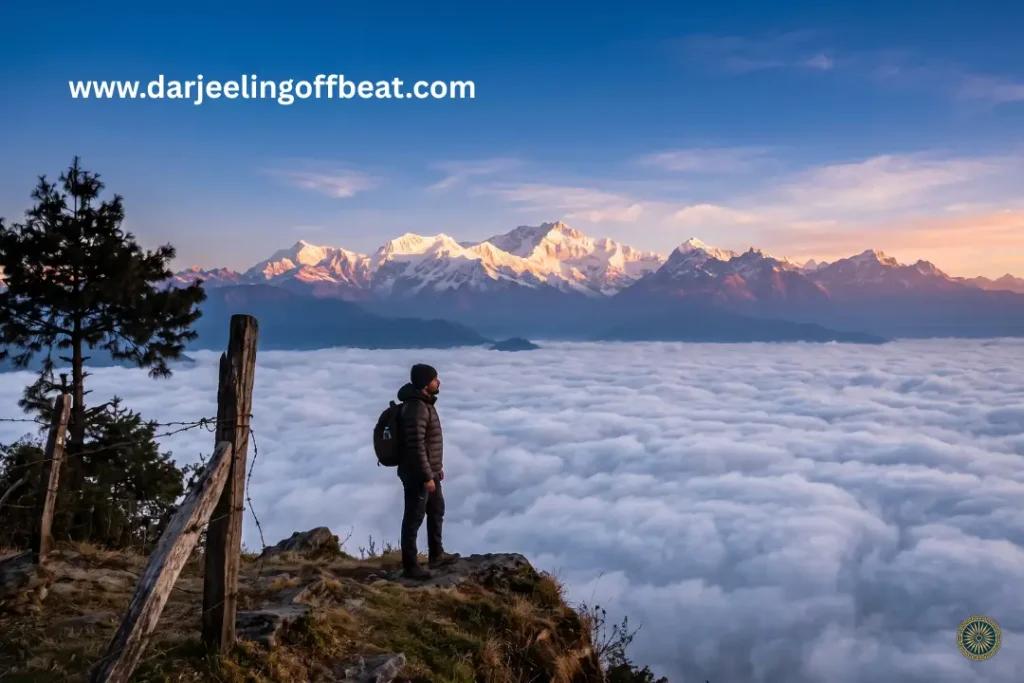
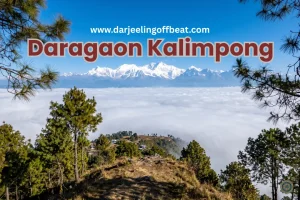
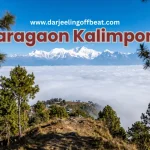
There’s a moment that happens at Daragaon — usually around six in the morning, usually in October or November — that people struggle to describe accurately afterwards. You’re standing at the edge of the ridge, and below you the entire Teesta valley has disappeared. Not into darkness, not into haze, but into a thick, white, rolling sea of cloud that has filled the gorge overnight and now sits below your feet like a floor of cotton. And above that cloud — impossibly large, impossibly close-seeming, glowing pink and gold in the first light — Kanchenjunga.
The world’s third-highest peak, floating above the clouds, while you stand on a quiet village ridge watching it happen.
This is why Daragaon is called the Balcony of Kanchenjunga. Not as a marketing phrase, but as a literal description of the view’s geometry: you are above the valley cloud, at the level of the mountain light, looking across at Kanchenjunga the way you’d look across a room. The intervening terrain has dropped into the gorge, the clouds have filled it, and there is nothing between you and the mountain except several hundred kilometres of clear Himalayan air.
Finding a place that delivers this reliably is rarer than it sounds. Daragaon does.
Daragaon Kalimpong Kanchenjunga view: The Name, the Place, the Position
Daragaon sits in the Kalimpong district of West Bengal, on a prominent mountain spur rising between 4,000 and 5,500 feet above sea level. The name itself is structural — “Dara” means high ridge or elevated crest in the local ethno-linguistic tradition, “Gaon” means village. Ridge Village. It does exactly what it says.
The settlement is also sometimes called Upper Icchey, which locates it precisely in relation to its neighbour — it sits directly above the contiguous hamlet of Icche Gaon, connected by trails that descend through forest between the two villages. Together they form one of the most coherent offbeat micro-circuits in the Kalimpong hills.
The ridge position is what makes everything work here. The village looks directly across the Teesta–Rangeet river valley system toward the principal Himalayan crest line. Because the terrain in between drops sharply into the Teesta gorge rather than presenting any intervening topographic barrier, the line of sight to Kanchenjunga is completely unobstructed. No shoulder ridge, no intermediate peak, no forest ridge blocking the view. Just the gorge, the cloud that fills it, and the mountain beyond.
The Science of the Sea of Clouds: Daragaon Kalimpong Kanchenjunga view
The cloud inversion that makes Daragaon’s view so distinctive isn’t luck or season — it’s physics, and it happens with enough regularity to plan around.
At night, radiational cooling causes dense, cold air to drain from the higher slopes and pool at the bottom of the Teesta River gorge. River moisture adds to this accumulation, and by early morning the gorge floor has filled with a thick layer of low stratus cloud — the valley completely hidden below a white surface. The process is consistent enough that on most clear mornings in the dry seasons, you can expect the cloud sea to be there.
What makes Daragaon’s position special is that the ridge sits above the cloud ceiling. When the valley fills below, the village remains under a clear sky. So observers at the ridge edge are positioned exactly as the name suggests — on a balcony above the clouds, looking outward at the same level as the mountain light.
The Kanchenjunga massif catches the sunrise long before the valley below does. At Daragaon, you see this happen: the peaks warm from cold blue to rose gold to brilliant white while everything below remains hidden in the valley cloud. It’s a view that has no convenient comparison, which is why people who’ve seen it tend to reach for the same inadequate words. Breathtaking. Otherworldly. Impossible.
None of them quite work. But they’re what people say.
Getting to Daragaon Kalimpong Kanchenjunga view
Daragaon sits within the Kalimpong hill network, accessible via routes that pass through some of the most scenic road corridors in the district.
From Kalimpong town: Approximately 20–25 kilometres, depending on the route taken. The road passes through lower Kalimpong settlements and then climbs toward the Icche Gaon–Daragaon ridge system.
From New Jalpaiguri (NJP): Around 85–90 kilometres — NJP is the primary railhead serving the region, well connected to Kolkata and major cities.
From Bagdogra Airport: Approximately 90–95 kilometres.
From Darjeeling: Daragaon is accessible from the Darjeeling side as well, via the Teesta valley route — roughly 50–55 kilometres depending on the road taken.
The final approach to Daragaon typically involves a stretch of narrower road through forest and terraced hillside. Shared jeeps from Kalimpong town serve the route, though private vehicle hire gives more flexibility for early morning departures — which matter here, because you want to arrive before sunrise.
The Village — What Daragaon Actually Is
Beyond the view, Daragaon is a small, genuine Himalayan village. Low density, dispersed settlement pattern — properties spread among pine forest and terraced farmland rather than concentrated in a market-street arrangement. The absence of any commercial centre is immediately noticeable and immediately welcome.
The community reflects the multi-ethnic character of the Kalimpong hills — Nepali, Lepcha, Bhutia households living alongside each other with Nepali as the common language of daily life. Farming is the baseline economy: terraced vegetable plots, small cardamom cultivation in the forest understorey, citrus orchards on the sheltered slopes. The homestay accommodation that has developed here is integrated directly into that farming life rather than existing separately from it.
There are roughly a handful of homestay properties at Daragaon, maintaining the low-density character of the ridge. This is not a village that has been scaled up for tourist volume. The view is the same whether ten people are watching it or a hundred, but the silence, the space, and the authenticity of the experience depend on the numbers staying small. So far, they have.
Staying Daragaon Kalimpong Kanchenjunga view — The Homestay Character
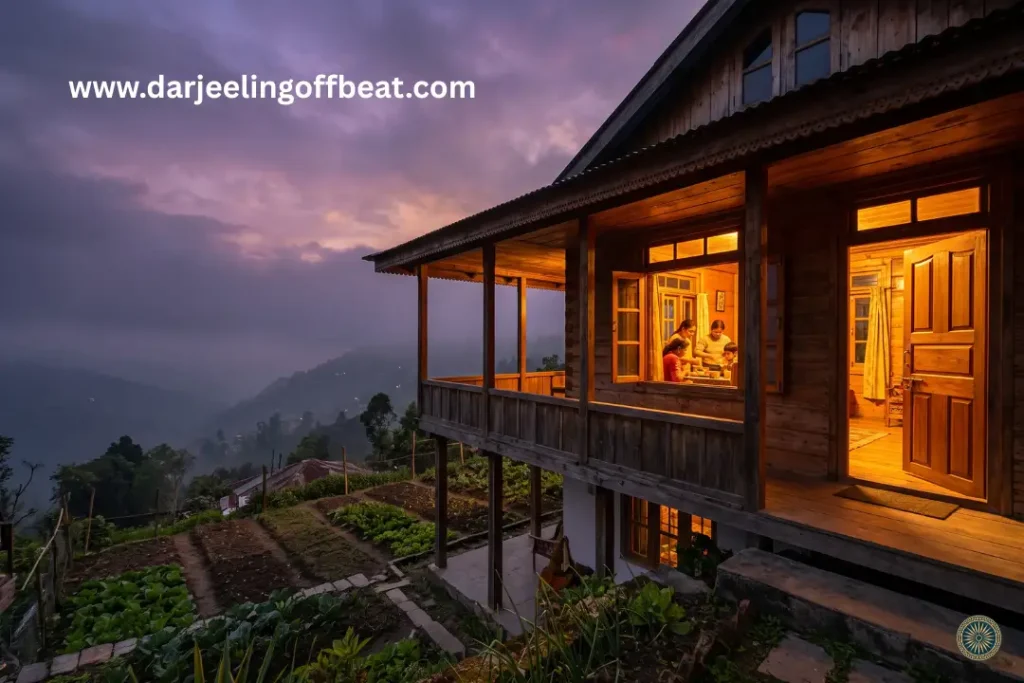
Accommodation at Daragaon is homestay-based throughout. Properties sit on the ridge with direct views toward Kanchenjunga — which means your morning routine involves walking to the edge of someone’s garden and watching the world’s third-highest peak emerge from clouds.
Meals are home-cooked from local ingredients. The staples of Kalimpong hill cuisine — dal, rice, seasonal vegetables from the terraced farms, eggs, occasionally chicken or pork — are served with the informal warmth of family hospitality rather than the managed efficiency of a restaurant. Evening meals on a clear night, eaten on a veranda with the ridge cooling around you and the valley lights appearing below as the cloud settles, are the kind of memory that travel is theoretically always supposed to produce but rarely does.
The homestay hosts here are typically the best guides available for the ridge and its trails. Ask about the walking route to Icche Gaon the evening before, and about the specific viewpoint to use for the sunrise. These are small pieces of local knowledge that make a significant difference to the experience.
The Cloud Sea — When and How to See It Best
The cloud inversion is most reliable and most dramatic during the dry seasons.
October to December is the peak period. Post-monsoon atmospheric clarity combines with the temperature differential that drives valley cloud formation, producing the sea-of-clouds effect with high regularity. October and November are particularly consistent. December remains excellent, but the cold intensifies considerably.
January and February bring the sharpest winter clarity when the morning cloud forms — on those mornings, Kanchenjunga appears with a precision that feels almost unreal, the snow surface detailed enough to read its texture from across the valley. Cold requires serious layering, but the conditions reward it.
March to May brings spring warmth, and the cloud formation becomes less regular as temperatures equalise. The view remains spectacular, but the sea-of-clouds effect is less guaranteed. What you gain is wildflowers, warmer mornings, and the greening of the forest.
Monsoon (June to September): Cloud everywhere, all the time, rain most days. The mountain view is largely absent. Come in another season.
The critical variable is always atmospheric clarity — check local weather reports and, if possible, speak with your homestay host about conditions before making a long drive for a specific morning view.
The Icche Gaon Connection — A Natural Circuit
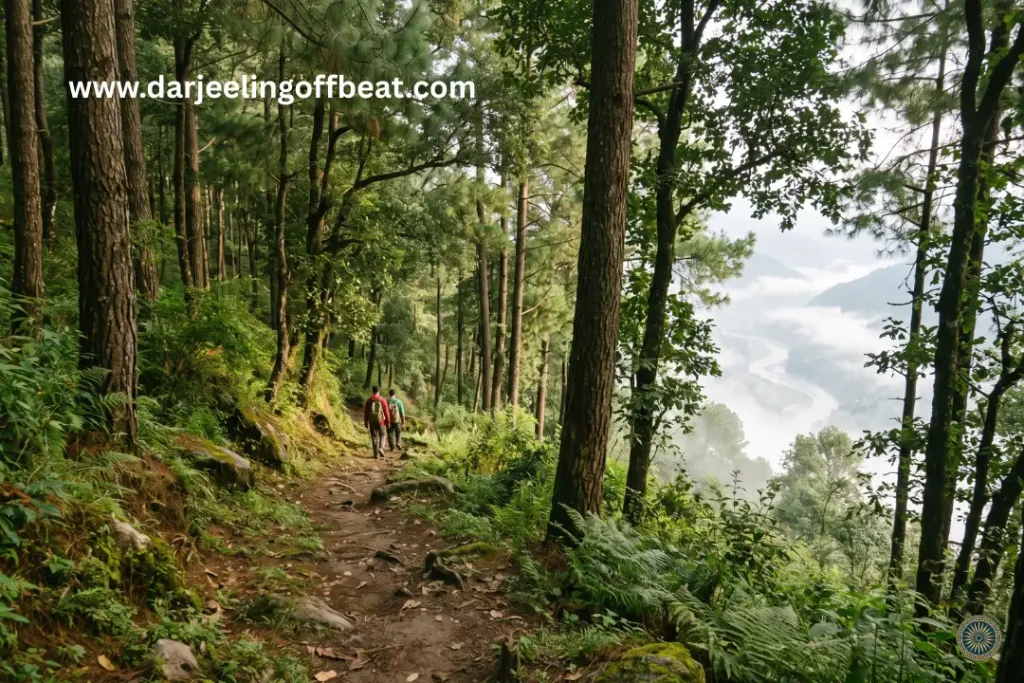
Daragaon and Icche Gaon together form one of the most satisfying short circuits in the Kalimpong hills. The two villages are connected by a forest trail that descends through pine and oak woodland from the upper Daragaon ridge down to the lower Icche Gaon settlement. The walk takes roughly 45 minutes to an hour depending on pace, and the trail passes through genuinely beautiful forest with the Teesta valley gradually becoming visible through the trees as you descend.
Icche Gaon itself — the name translates roughly to “wish village” — sits at a lower elevation and has a somewhat different character: more established in the offbeat tourism circuit, slightly better infrastructure, and a complementary view perspective that shows the valley from a different angle. Combining a night or two at Daragaon with a night at Icche Gaon gives you the full ridge experience — cloud-sea views from above and valley views from lower down — within a single, walkable mini-itinerary.
The broader micro-circuit also connects to Barmek and Ramdhura via trail and road, making this entire ridge system one coherent offbeat destination.
Other Things to Do at Daragaon
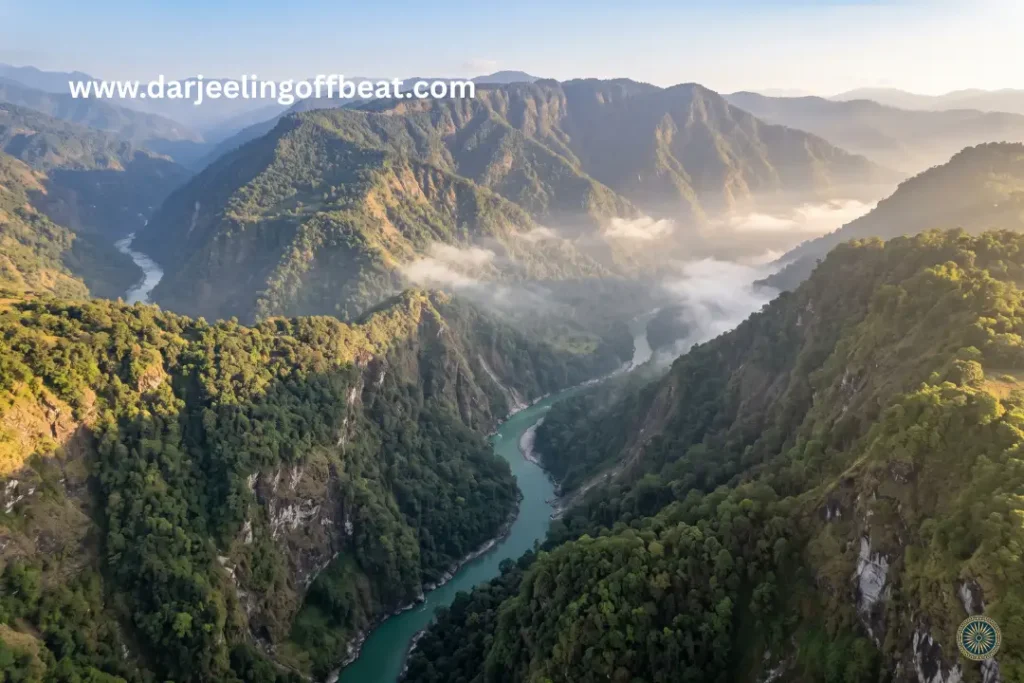
The sunrise is the headline, but the village sustains attention across a full stay.
Forest walks through the pine and oak woodland surrounding the ridge offer quiet morning hours after the sunrise, when the light softens, and the forest comes fully alive with birdsong. The Eastern Himalayan forest at this elevation is biodiverse and largely undisturbed — birdwatching here requires no specialist equipment, only patience and an early start.
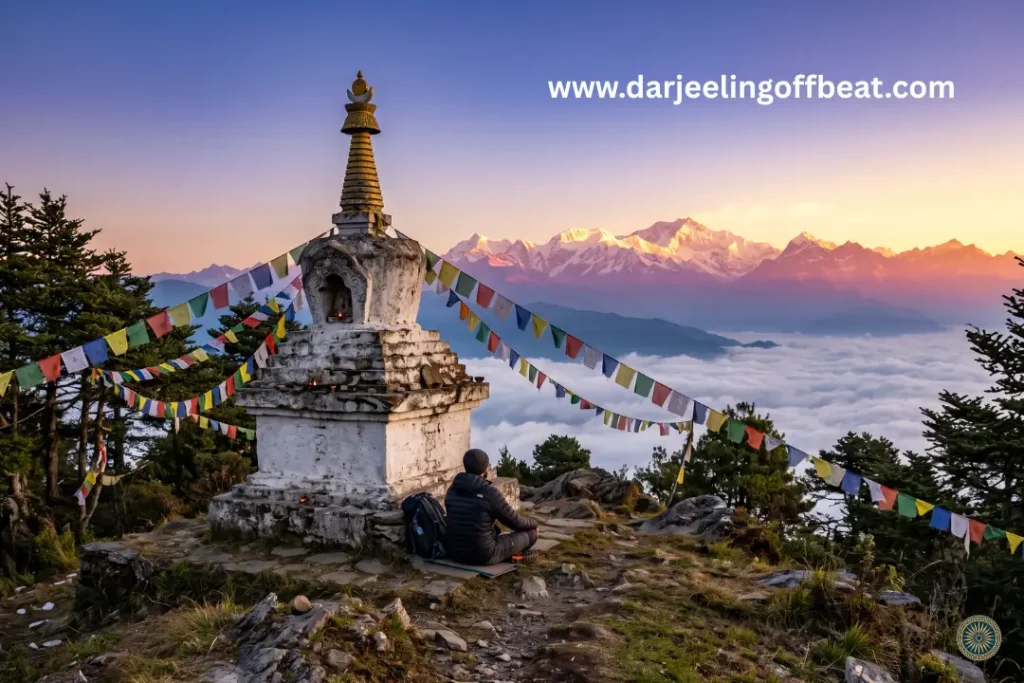
Trail to the hilltop Chorten — a Buddhist stupa sits above the village on the highest point of the ridge, reachable by a short uphill walk. The view from the Chorten adds elevation and a slightly different angle to the Kanchenjunga panorama. The Chorten itself is a simple, weathered structure — not a monument to visit but a landmark to sit beside while the morning light changes.
Photography across the full arc of the day — the sea of clouds at dawn, the mountain in full light by mid-morning, the valley filling with afternoon haze, the ridge light going golden before sunset, the village lights appearing below as darkness comes. Daragaon has enough visual material to occupy a camera seriously for two or three days.
The terrace farms — walking through the working agricultural landscape of the ridge, watching what’s being grown and how- is a grounding counterpoint to the spectacular scenery. The people farming these terraces are the same families hosting you for dinner. That continuity is part of what makes this kind of travel meaningful.
The Wider Kalimpong Offbeat Network
Daragaon sits naturally within a broader cluster of offbeat destinations across the Kalimpong hills that can be combined into a five- to seven-day circuit without the kind of backtracking that makes itinerary planning frustrating.
Icche Gaon — directly below, connected by walking trail.
Ramdhura — at 5,000 feet on the same ridge system, with complementary forest trekking routes.
Barmek — connecting to the ridge network and the Teesta view corridor.
Sillery Gaon — accessible via scenic forest paths, with access to the Damsoang Fort ruins.
Bhalukhop — the sunrise point village on the Kalimpong outskirts, offering a different ridge character.
The Teesta River itself — reachable from the valley below Daragaon — adds a riverine dimension to what is otherwise a ridge-and-forest itinerary.
Why Daragaon Kalimpong Kanchenjunga view Specifically
There are other places in the Kalimpong hills — and in the wider Darjeeling-Sikkim region — where you can see Kanchenjunga. Tiger Hill above Darjeeling is the famous one. Sandakphu is the definitive one. Pelling in Sikkim offers its own version.
Daragaon is different from all of them in one specific way: the cloud inversion. The sea-of-clouds below your feet while the mountain stands clear above is a view configuration that depends on very particular topography — a high ridge above a deep river gorge, positioned directly across from the peak, with no intervening terrain. That combination is not common. Daragaon has it.
The other difference is simply the absence of crowds. Tiger Hill before sunrise is a managed tourist event. Sandakphu requires a multi-day trek. Daragaon is a three-hour drive from NJP and a village ridge walk from your homestay. The same Kanchenjunga, radically different context.
That context — the quiet, the forest, the farming village, the family breakfast before the mountain appears — is not incidental to the experience. For many people who come here, it is the experience.
Elevation: 4,000–5,500 ft (1,200–1,675 m)
Also known as: Upper Icchey
District: Kalimpong, West Bengal
From NJP: ~85–90 km | From Bagdogra: ~90–95 km | From Darjeeling: ~50–55 km
Best seasons: October–December and March–May
Signature experience: Sea-of-clouds + Kanchenjunga sunrise from the ridge
Circuit: Icche Gaon, Ramdhura, Barmek, Sillery Gaon, Bhalukhop
Don’t miss: Pre-dawn ridge walk, hilltop Chorten view, forest trail to Icche Gaon
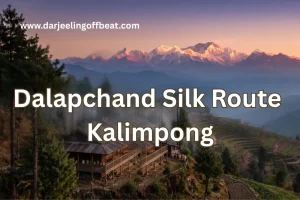
Dalapchand Silk Route Kalimpong: Where West Bengal Meets Sikkim
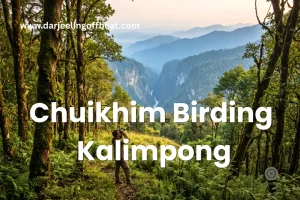
Chuikhim birding Kalimpong: That Sits Between Two Worlds
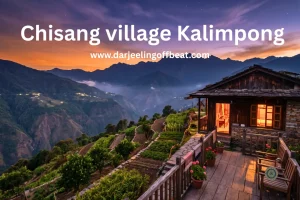
Chisang Village Kalimpong: Where India Ends, and Bhutan Begins
- Kashyem Kaman Kalimpong Teesta Rangpo Confluence View 2026: The Cedar Ridge
 Kashyem Kaman Kalimpong Teesta Rangpo confluence view — Teesta-Rangpo confluence below and Kanchenjunga above — plus Cinchona heritage trails and cedar forest homestays at ₹1,250/day. There is a specific kind of view that requires exactly the right elevation — too high and the cloud covers everything, too low and the angle is wrong. Kashyem Kaman …
 - Kalijhora Homestay & Teesta Travel Guide: How a Picnic Spot Turned Into North Bengal’s Quietest Adventure HubKalijhora homestay guide: where to stay near the Teesta, rafting routes & prices, Panboo ridge views, and everything to plan your North Bengal trip If you’ve driven up NH10 from Siliguri toward Kalimpong or Darjeeling, you’ve passed through Kalijhora without necessarily noticing it. That’s kind of the point. It sits about 28 kilometres north of …
- Goiri Gaon, Kalimpong: The Village the Forest Kept Secret — Now With the Full StoryGoiri Gaon Kalimpong Neora Valley offbeat — red panda corridor, Maria Busty 1891 church, Pedong Silk Route ruins, and homestay-only model. Complete offbeat guide inside. There are places in the Eastern Himalayas that exist in a kind of geographical grace — tucked far enough from the main roads that the noise of modern hill tourism …
- Gitkolbong Village Kalimpong: The Village That Climbs From River to RidgeGitkolbong village Kalimpong near Lava, with tea plantations, the Gitkhola river, and a ridge trail to Gitkolbong Top with Kanchenjunga views. Complete offbeat travel guide inside. Some places reveal themselves slowly. You arrive, and the first impression is modest — a quiet mountain village, some terraced farmland, a stream you can hear before you see …
- Daragaon Kalimpong Kanchenjunga View Where the Clouds Stay Below YouDaragaon Kalimpong Kanchenjunga view— offers a rare sea-of-clouds sunrise view with the world’s third-highest peak floating above the Teesta valley. Complete travel guide inside. There’s a moment that happens at Daragaon — usually around six in the morning, usually in October or November — that people struggle to describe accurately afterwards. You’re standing at the …
- Dalapchand Silk Route Kalimpong: Where West Bengal Meets SikkimSome destinations, like Dalapchand Silk Route Kalimpong, exist because someone put them on a map, and others exist because the landscape demanded them. Dalapchand is the second kind. Sitting right on the border zone between Kalimpong district in West Bengal and Pakyong district in East Sikkim, this quiet mountain hamlet occupies a genuinely rare position. …
- Chuikhim birding Kalimpong: That Sits Between Two WorldsThere’s a particular kind of traveller who plans a trip around a bird. Who wakes before the alarm, walks quietly into the forest before dawn, and stands absolutely still for twenty minutes because something small and extraordinary might appear in the canopy above. If you know this feeling — or suspect you might — then …
- Chisang Village Kalimpong: Where India Ends and Bhutan BeginsThere’s something quietly extraordinary about standing at the edge of a country and not at an airport or a formal border crossing, but on a hillside at dusk, looking across a valley into another nation’s lights. No fence in sight, no checkpoint, just a ridge and a silence and the slow understanding that the world …
- Bidyang Village, Kalimpong: A Riverside Escape You Didn’t Know You NeededSome places earn their reputation through grandeur — towering peaks, famous monasteries, names that appear on every travel list. And then there are places like Bidyang Kalimpong, which earn theirs more quietly. The sound of a river running over stones. The smell of cardamom on a warm afternoon. A valley so tucked away from the …






North Bengal's offbeat magic is my muse. I find adventure in whispering waterfalls, vibrant village life, and breathtaking Himalayan vistas. Join me as I delve deeper, seeking stories and experiences beyond the mainstream, from Darjeeling's tea havens to the unexplored corners of this incredible region