
There are places in the mountains that stop you mid-breath. Not because they’re dramatic in the Instagram-reel kind of way, but because they offer something quieter and rarer — a view that feels almost impossible. Snow-capped peaks on one side, a river gorge plunging thousands of feet below on the other, and you standing somewhere in between, wondering how one small hilltop managed to earn all of this.
That place is Barmek Village Kalimpong. And if you haven’t heard of it yet, that’s honestly part of its charm.
Barmek Village Kalimpong on the Edge of Everything
Tucked into the ridgeline of Kalimpong district in West Bengal, Barmek sits at roughly 4,800 feet above sea level — high enough to feel the cool mountain air year-round, but not so remote that getting there becomes an expedition.
Locals also call it Burmiak, Bermek, or Barmik depending on who you ask, and that small inconsistency feels fitting for a place that resists easy categorisation.
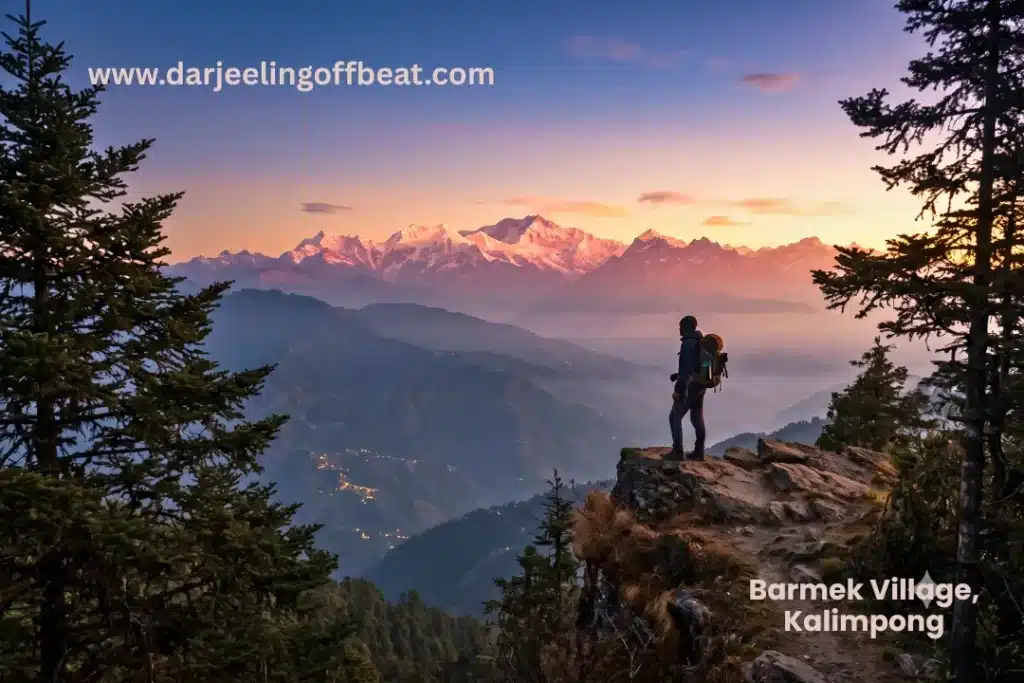
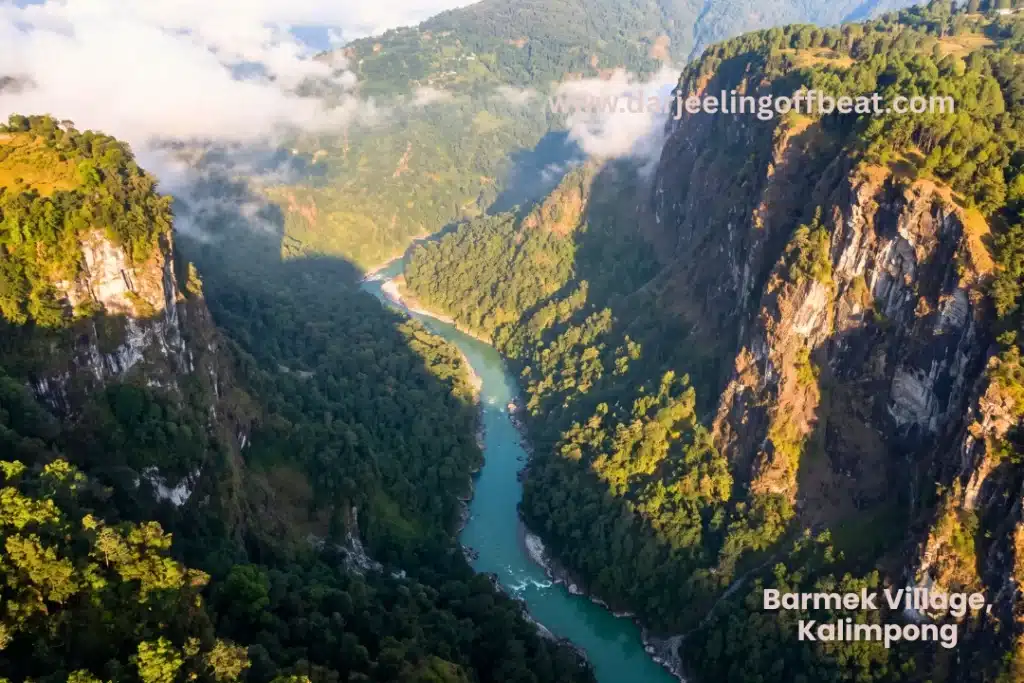
What makes Barmek genuinely unusual is its geography. The village perches on an elevated spur near the West Bengal–Sikkim border, and because of how the ridge is angled, you get a direct, unobstructed sightline to the Kanchenjunga massif — the world’s third-highest peak — while simultaneously looking straight down into the gorge where the Teesta River winds its way through the valley below.
That vertical contrast, from glacial alpine heights to subtropical river floor, all within a single visual frame, is something most Himalayan viewpoints simply don’t offer. Most places give you either the peaks or the river. Barmek gives you both.
The best time to see Kanchenjunga clearly is during dawn and early morning, when the atmosphere is sharpest. On a clear day, the mountain seems almost close enough to touch — though it’s miles away, of course.
Getting There
Barmek is about 16 to 18 kilometres from Kalimpong town, which makes it a comfortable day trip or an easy overnight if you want to wake up to that mountain view at sunrise (which, for the record, you absolutely should).
From New Jalpaiguri railway station, the distance is around 92 kilometres, and from Bagdogra Airport, roughly 98 kilometres. The roads through this part of the Kalimpong hills are scenic, winding, and occasionally demanding — but that’s half the experience.
When to Go Barmek Village Kalimpong
The mountains have their moods, and Barmek is no exception. There are two windows when this village really shines.
Spring (March to May) brings clear skies, flowering hillsides, and that particular freshness in the air that makes you want to walk everywhere. The visibility of Kanchenjunga during these months is exceptional.
Autumn (September to November) is arguably even better. The monsoon has washed the atmosphere clean, the valley is lush and green, and the early morning views of the snow peaks feel almost cinematic.
The monsoon itself — June through August — is a different story. Heavy rain, dense fog, and the occasional road blockage make travel unpredictable. Some visitors still come during this period for the dramatic mist-wrapped scenery, but it’s not the ideal time if Kanchenjunga views are your priority.
Barmek Village Kalimpong with Real History
Barmek isn’t just a pretty viewpoint with a few homestays. It carries layers of history that most visitors never fully explore.
Before the Anglo-Bhutan War of 1864–65, this entire region was part of the Dalingkot territory under the Kingdom of Bhutan. After the Treaty of Sinchula in 1865, the British annexed these hill tracts and folded them into what would become the Darjeeling and Kalimpong districts.
The broader region gained strategic importance as a corridor connecting Bengal to Tibet via the Jelep La Pass — a trans-Himalayan trade route that shaped the culture and economy of these hills for generations.
The indigenous communities here — primarily Lepchas, Bhutias, and Limbus — had long established terraced agricultural systems adapted to the steep slopes. Then, in the late nineteenth century, the British introduced something new: Cinchona plantations.
The bark of the Cinchona tree was the primary natural source of quinine, which was used to treat malaria across British India. These colonial-era plantations left a lasting imprint on the landscape, and you can still see Cinchona trees standing alongside native pine forests and citrus orchards across the Barmek and Kashyem ridge systems.
Today, that agricultural heritage continues in a contemporary form. Local farmers grow organic vegetables — pesticide-free, cultivated the slow, careful way — and maintain orange groves that supply both village households and the local homestays. When you eat here, there’s a decent chance your meal came from a farm you walked past that morning.
Life in the Village — All 35 Households of It
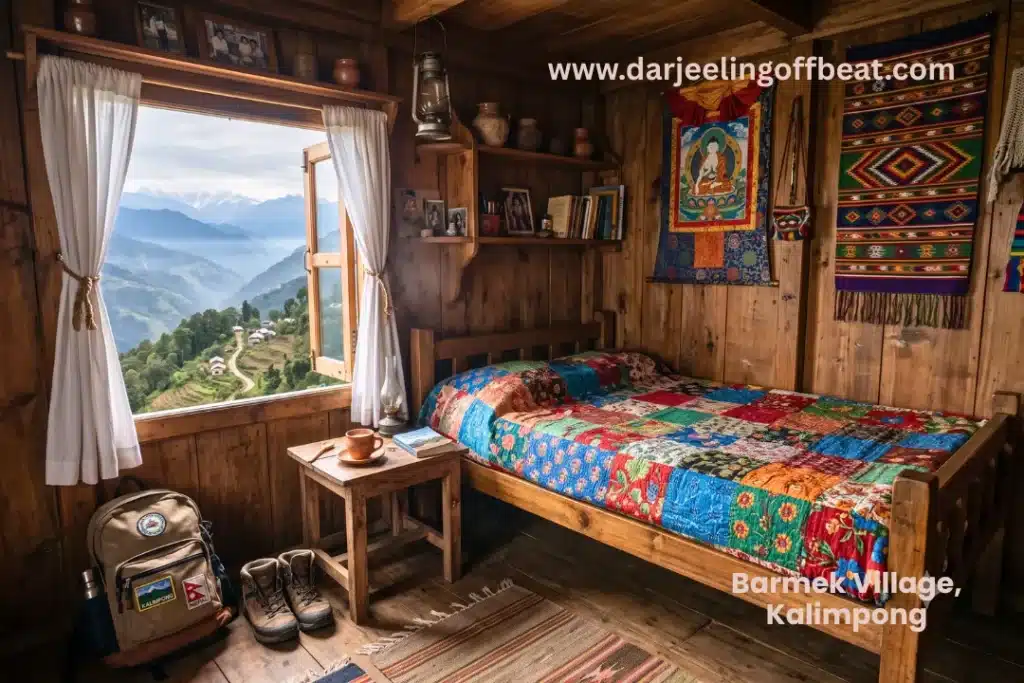
Barmek Village Kalimpong is small. There are roughly 35 households in the village, and almost all of them participate in what’s essentially a universal homestay model — meaning the community has collectively oriented itself around welcoming travellers in an intimate, family-run way. This isn’t a resort destination.
There are no lobbies, no buffet breakfasts, no room service. What there is, instead, is a spare room in someone’s home, a meal cooked on a wood-fired stove, and a family who’ll tell you exactly where to stand at sunrise to catch Kanchenjunga at its most golden.
That kind of travel is harder to find than it used to be. Barmek still offers it.
What to Do Here
The honest answer is: slow down. But if you need a more concrete itinerary, here’s where Barmek Village Kalimpong will take you.
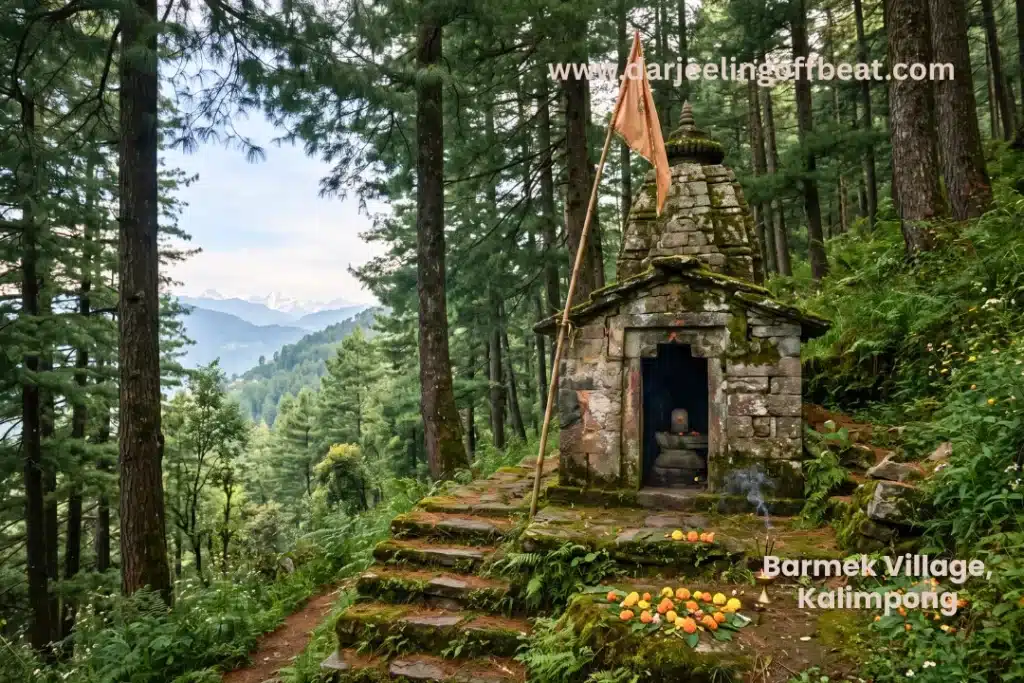
Nature trails through pine forests wind out from the village core toward hilltop Chortens — Buddhist stupas set on high ridges with sweeping views of the surrounding valleys. These are unhurried walks, the kind where you stop often and pretend you’re catching your breath when really you’re just looking.
The Barmek Cave and Barmek Mahadev Temple are local landmarks worth visiting — particularly the temple, which sits within a natural landscape that feels quietly sacred even to non-religious visitors.
The terraced agricultural plots aren’t tourist attractions in the formal sense, but walking among the orange groves and vegetable farms, especially during harvest season, offers a glimpse of daily life that’s genuinely grounding.
The Wider Circuit — Villages Worth Connecting
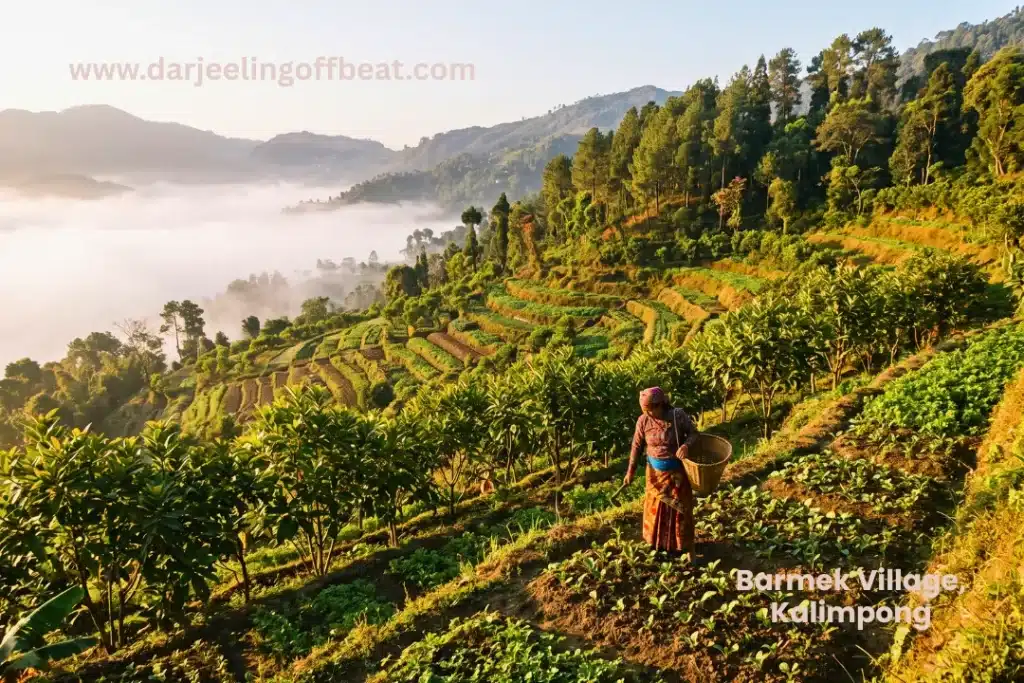
Barmek Village Kalimpong works beautifully as a standalone destination, but it also sits at the centre of a cluster of offbeat hamlets that can be combined into a longer Kalimpong hills itinerary.
Daragaon, perched on a pine-clad hill crest nearby, is locally called the “Balcony of Kanchenjunga” — which tells you everything about its views.
Icche Gaon and Ramdhura (at 5,000 feet, slightly higher than Barmek) offer complementary vantage points and established forest trekking routes that connect the villages through dense woodland.
Sillery Gaon is reachable via scenic forest paths and offers access to the ruins of Damsoang Fort — a historical site that most visitors to this region never find.
For something completely different in texture, the Bidyang Valley along the Reli River provides low-altitude riverine scenery that contrasts beautifully with the high-ridge world of Barmek. And the Teesta River itself — about 8 kilometres from the village — is there for those who want to trade mountain views for angling, riverbank walks, or white-water rafting.
Why Barmek, and Why Now
The Himalayan tourism circuit has a well-worn groove — Darjeeling, Gangtok, Pelling, maybe Lachen. Those places are wonderful, but they’re also crowded in a way that makes quiet mornings difficult and authentic local interaction increasingly rare.
Barmek is what those places used to feel like. A small community, a spectacular location, and the kind of unhurried atmosphere where you can actually hear the wind moving through the pine trees. The infrastructure here is modest but functional. The welcome is genuine. And the view — that extraordinary, improbable view of Kanchenjunga above and Teesta below — is something you’ll find yourself describing to people for years.
Some places deserve to stay offbeat. Barmek Village Kalimpong is one of them. Visit before the secret gets too widely shared.
Getting here: ~16–18 km from Kalimpong town | 92 km from NJP | 98 km from Bagdogra Airport
Best seasons: March–May and September–November
Stay: Village homestays (approximately 35 households)
Don’t miss: Sunrise view of Kanchenjunga, Barmek Mahadev Temple, trail to the hilltop Chorten
In the above blog post, all necessary information regarding Barmek village Kalimpong, offbeat places near Kalimpong, Barmek homestay, Kanchenjunga view from Kalimpong, Barmek Kalimpong travel guide, offbeat villages West Bengal hills, Burmiak village Kalimpong, Teesta river view Kalimpong, Kalimpong offbeat tourism, Barmek cave Kalimpong,
Barmek Mahadev temple, Daragaon Kalimpong, Icche Gaon Kalimpong, Ramdhura village, Sillery Gaon trekking, offbeat North Bengal tourism, places to visit near Kalimpong, Kalimpong ecotourism, West Bengal Sikkim border village, hill villages near Darjeeling are covered.
- Kashyem Kaman Kalimpong Teesta Rangpo Confluence View 2026: The Cedar Ridge
 Kashyem Kaman Kalimpong Teesta Rangpo confluence view — Teesta-Rangpo confluence below and Kanchenjunga above — plus Cinchona heritage trails and cedar forest homestays at ₹1,250/day. There is a specific kind of view that requires exactly the right elevation — too high and the cloud covers everything, too low and the angle is wrong. Kashyem Kaman …
 - Kalijhora Homestay & Teesta Travel Guide: How a Picnic Spot Turned Into North Bengal’s Quietest Adventure HubKalijhora homestay guide: where to stay near the Teesta, rafting routes & prices, Panboo ridge views, and everything to plan your North Bengal trip If you’ve driven up NH10 from Siliguri toward Kalimpong or Darjeeling, you’ve passed through Kalijhora without necessarily noticing it. That’s kind of the point. It sits about 28 kilometres north of …
- Goiri Gaon, Kalimpong: The Village the Forest Kept Secret — Now With the Full StoryGoiri Gaon Kalimpong Neora Valley offbeat — red panda corridor, Maria Busty 1891 church, Pedong Silk Route ruins, and homestay-only model. Complete offbeat guide inside. There are places in the Eastern Himalayas that exist in a kind of geographical grace — tucked far enough from the main roads that the noise of modern hill tourism …
- Gitkolbong Village Kalimpong: The Village That Climbs From River to RidgeGitkolbong village Kalimpong near Lava, with tea plantations, the Gitkhola river, and a ridge trail to Gitkolbong Top with Kanchenjunga views. Complete offbeat travel guide inside. Some places reveal themselves slowly. You arrive, and the first impression is modest — a quiet mountain village, some terraced farmland, a stream you can hear before you see …
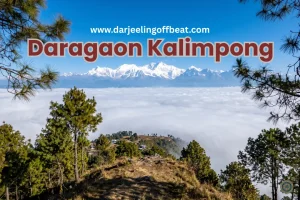
- Daragaon Kalimpong Kanchenjunga View Where the Clouds Stay Below YouDaragaon Kalimpong Kanchenjunga view— offers a rare sea-of-clouds sunrise view with the world’s third-highest peak floating above the Teesta valley. Complete travel guide inside. There’s a moment that happens at Daragaon — usually around six in the morning, usually in October or November — that people struggle to describe accurately afterwards. You’re standing at the …
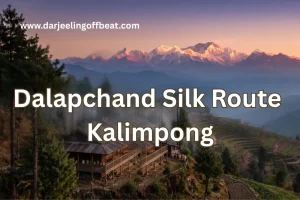
- Dalapchand Silk Route Kalimpong: Where West Bengal Meets SikkimSome destinations, like Dalapchand Silk Route Kalimpong, exist because someone put them on a map, and others exist because the landscape demanded them. Dalapchand is the second kind. Sitting right on the border zone between Kalimpong district in West Bengal and Pakyong district in East Sikkim, this quiet mountain hamlet occupies a genuinely rare position. …
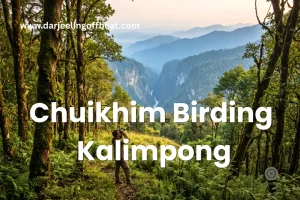
- Chuikhim birding Kalimpong: That Sits Between Two WorldsThere’s a particular kind of traveller who plans a trip around a bird. Who wakes before the alarm, walks quietly into the forest before dawn, and stands absolutely still for twenty minutes because something small and extraordinary might appear in the canopy above. If you know this feeling — or suspect you might — then …
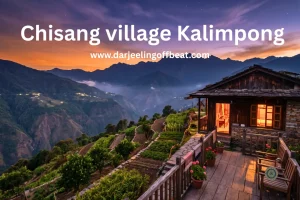
- Chisang Village Kalimpong: Where India Ends and Bhutan BeginsThere’s something quietly extraordinary about standing at the edge of a country and not at an airport or a formal border crossing, but on a hillside at dusk, looking across a valley into another nation’s lights. No fence in sight, no checkpoint, just a ridge and a silence and the slow understanding that the world …
- Bidyang Village, Kalimpong: A Riverside Escape You Didn’t Know You NeededSome places earn their reputation through grandeur — towering peaks, famous monasteries, names that appear on every travel list. And then there are places like Bidyang Kalimpong, which earn theirs more quietly. The sound of a river running over stones. The smell of cardamom on a warm afternoon. A valley so tucked away from the …




North Bengal's offbeat magic is my muse. I find adventure in whispering waterfalls, vibrant village life, and breathtaking Himalayan vistas. Join me as I delve deeper, seeking stories and experiences beyond the mainstream, from Darjeeling's tea havens to the unexplored corners of this incredible region