
Kalijhora homestay guide: where to stay near the Teesta, rafting routes & prices, Panboo ridge views, and everything to plan your North Bengal trip
If you’ve driven up NH10 from Siliguri toward Kalimpong or Darjeeling, you’ve passed through Kalijhora without necessarily noticing it. That’s kind of the point. It sits about 28 kilometres north of Siliguri, right where the Darjeeling and Kalimpong districts meet, and for most of its history it was known for one thing: a good riverbed to spread a mat on and eat lunch by.
Families would come up from the plains in winter, park themselves on the wide, sun-baked banks of the Teesta, and go home before dark. Nothing more complicated than that.
The name itself comes from a small mountain stream — Kalijhora literally means “Black Stream” — that tumbles down from the thick forest cover of the Mahananda Wildlife Sanctuary before joining the Teesta. It’s a modest little watercourse, but it gave the whole settlement its identity.
A Bollywood Bungalow, Gone and Rebuilt
Here’s a detail most people driving through have no idea about: Kalijhora had a Bollywood moment. Back in 1981, the old PWD inspection bungalow here was the main filming location for Barsaat Ki Ek Raat, released in Bengali as Anusandhan, with Amitabh Bachchan and Rakhee. That colonial-era bungalow didn’t survive the political unrest of the late ’80s — it was destroyed — but the state eventually rebuilt on the same footprint, so the location itself, in a sense, is still standing.
The Dam Changed Everything
For decades, Kalijhora‘s economy ran on day-trippers. Then the Teesta Low Dam Project happened, and the river simply stopped behaving the way it used to. Once the barrage went up, water velocity downstream changed, the water table rose, and a lot of the low riverbank that people used to picnic on just went under. That one piece of engineering effectively ended Kalijhora‘s identity as a day-picnic town.
What it couldn’t end, though, was tourism itself — it just redirected it. The area pivoted toward overnight stays: eco-tourism, adventure camps, and transit lodging for people heading further up into the hills. And there was an unexpected bonus buried in the dam’s construction — a heavy vehicular bridge across the river basin.
That bridge opened up road access to ridge villages on the eastern bank that had been more or less cut off before: Panboo, Barbatey, Joretar, Makum. Almost overnight, Kalijhora stopped being a dead-end picnic spot and became a gateway — a place you pass through on your way somewhere higher and quieter.
Kalijhora Homestay Options: Where to Actually Stay
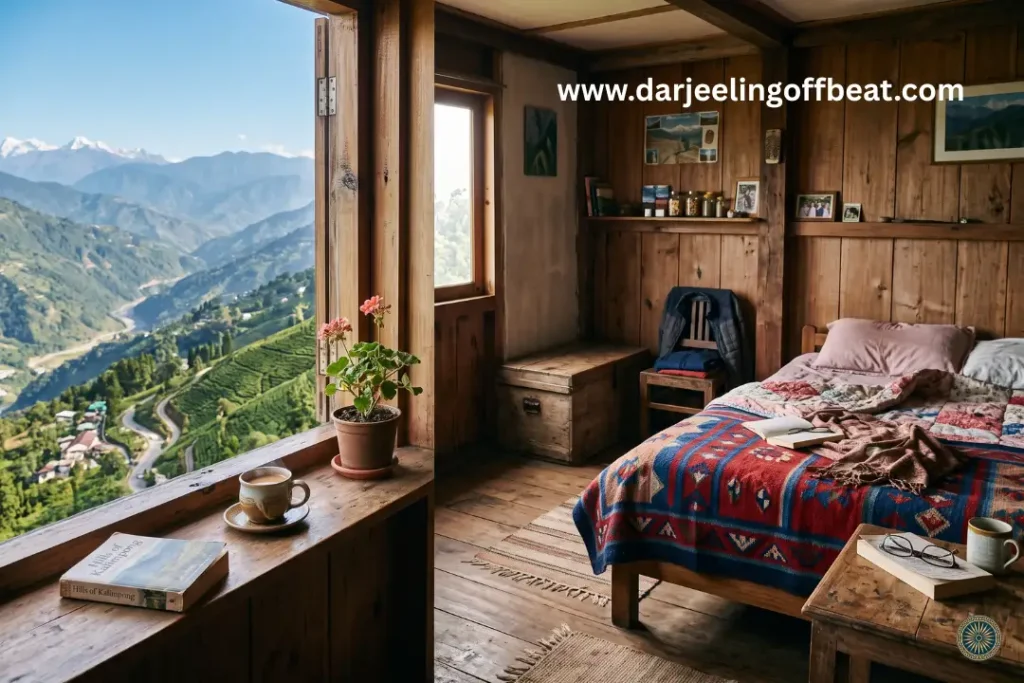
The lodging scene around Kalijhora breaks down into three fairly distinct categories, and which one suits you depends a lot on what kind of trip you’re after. If you’re specifically hunting for a Kalijhora homestay, though, you’ll find it’s by far the most common — and usually the most rewarding — way to stay here.
Village homestays are the backbone of the local hospitality economy — they make up close to 60% of everything on offer here. A Kalijhora homestay is typically small, family-run, and built around exactly the kind of quiet you came looking for. Expect to pay somewhere around ₹2,168 a night on average, though if you’re not fussy, more than a third of properties fall comfortably in the ₹1,000–2,000 range.
Amenities are basic but not primitive: roughly half the homestays have Wi-Fi, a similar share offer parking, about three in ten have a garden or private yard, and just under a quarter will let you bring a pet.
A couple of names worth knowing: Teesta River View Homestay in Mangarjung sits inside the Munsong Cinchona plantation and leans into that rural quiet — organic, home-cooked meals, hot water, private balconies overlooking the gorge. Teesta Homestay, closer to the bridge itself, offers deluxe non-AC doubles (around 100 sq. ft.) with their own washrooms and balconies, and the caretakers will cook to your preferences if you ask.
Most private homestays keep it simple: check in anywhere between noon and 9 PM, check out by 11 — one more reason a Kalijhora homestay tends to feel easier to book than a government lodge.
State forest lodges are the other option, and they feel like a completely different kind of trip. These fall under the West Bengal Forest Development Corporation and the state tourism department. The closest one is Mongpong Nature Resort, 8 km south of Kalijhora — four raised timber cottages named after local bird species, two with AC and two without, all looking straight down onto Sal and Teak canopy above the riverbed.
Further up, there’s a rest house at Latpanchar, inside the Mahananda sanctuary, running around ₹900 a night.
Booking one of these government properties is a more rigid affair than a homestay. Reservations open exactly 90 days ahead and need full payment upfront. Check-in is fixed at noon, check-out at 10 AM sharp, and once you’ve booked, you can’t change the dates or the location — no flexibility there. Two kids under 10 stay free; an extra bed costs ₹200 (non-AC) or ₹300 (AC) per night.
And worth knowing before you go: if the grid goes down, the backup generator only runs from 6 to 10 PM, and even then, AC units and water heaters get cut off to conserve power.
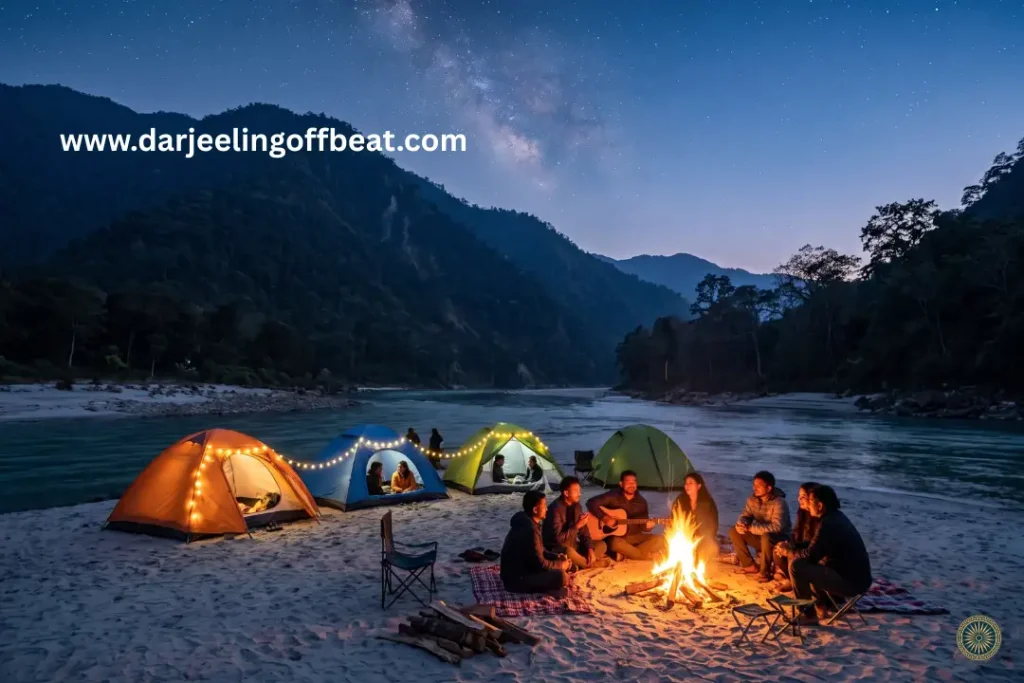
Then there’s Triveni — upstream, where the Teesta meets the Great Rangeet — and this is a completely different experience again. This is beach camping in the literal sense: operators pitch tents right on the river sand. It’s priced simply, ₹1,500 per person per night, and that covers pretty much everything — the tent and bedding, evening tea and snacks, a barbecue dinner by the bonfire, some beach volleyball if you’re up for it, and breakfast before you’re expected to check out at 10 AM.
The Rafting, and Why It’s Worth Planning Around
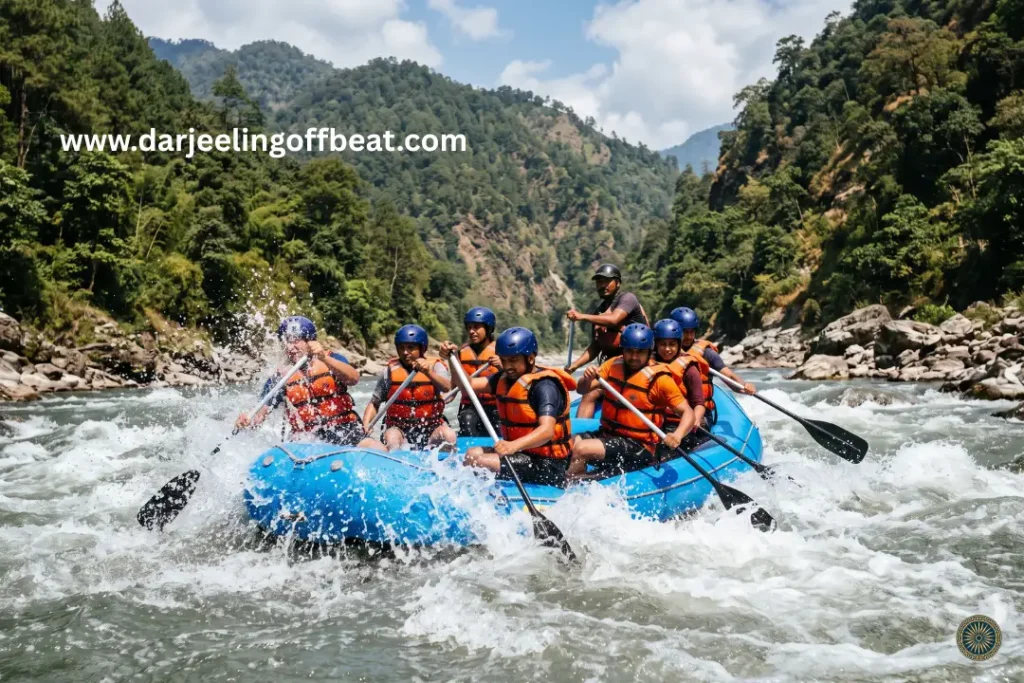
The stretch of the Teesta running from Tarkhola down through Melli, Teesta Bazar, and Kalijhora is probably the single best white-water rafting corridor in eastern India. The rapids range from Grade I — gentle enough for someone who’s never rafted in their life — up to technical Grade IV sections that demand real paddling skill.
There are, broadly, three routes to choose from:
The short route runs from Melli or Bhalu Khola down to 29 Mile or the Teesta Bridge — just 3 to 7 km of Grade I–II water, ideal if you’ve got kids along or you’re not confident in the water. It’ll cost you ₹500–800 a head, or ₹3,999–4,999 if you’d rather book the whole raft.
The middle route, from Triveni or Teesta Bazar to Melli Bridge, stretches 11–12 km through Grade II–III rapids. This is the one most general tourists end up on — enough thrill to feel like an adventure, not so much that it’s terrifying. Figure ₹900–1,200 per person, or ₹7,499–7,999 per raft.
Then there’s the long haul — Tarkhola to Melli Bridge, 18 to 20 km of Grade III–IV water. This one’s for people who’ve rafted before and are comfortable in the water. It runs ₹1,500–2,000 a head, or up to ₹13,999 for the raft.
Most operators let you choose between paying per person or chartering the whole raft, which typically seats six adults plus a certified guide.
Geographically, the difficulty tapers as you move downstream. Up near Tarkhola and Triveni, the gradient is steepest, and the rapids are genuinely technical. By the time the river reaches Triveni to Melli, things mellow into a mix of moderate rapids and long, calm pools — which is exactly why that stretch is the most booked. Further down, past Melli toward 29 Mile and Kalijhora, the water gentles out into Grade I–II territory, more or less built for families and nervous first-timers.
One thing to keep firmly in mind: this is a seasonal activity. Rafting runs from December through June, when the water’s calmer and more predictable. Come monsoon — July through September — everything stops. The river swells too much and gets too dangerous, and operators simply won’t take you out. Whenever you do go, expect a safety briefing, a certified guide, a life jacket, and a helmet as standard, non-negotiable equipment — even on the easy stretches.
Climbing Out of the Valley: Panboo and the Ridge Villages
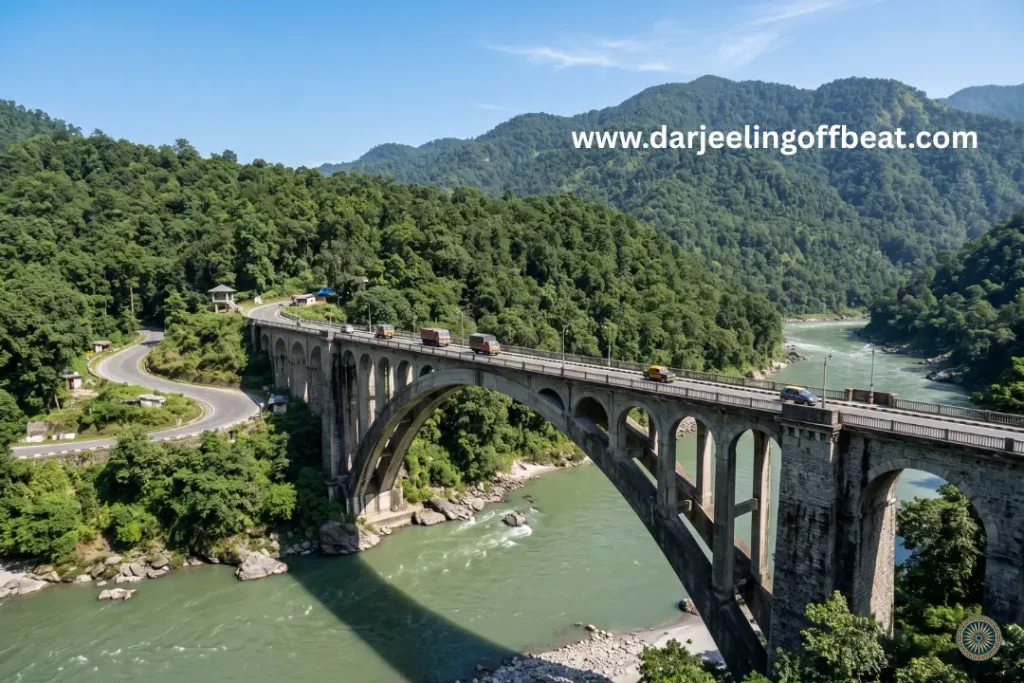
Kalijhora isn’t really a destination in itself so much as a launch point. Cross the Teesta Low Dam bridge and start climbing — the road up to Panboo winds through gradients as steep as 65 to 70 degrees over about 25 kilometres — and within a fairly short distance you go from 300 feet above sea level at the river to over 5,500 feet on the ridge.
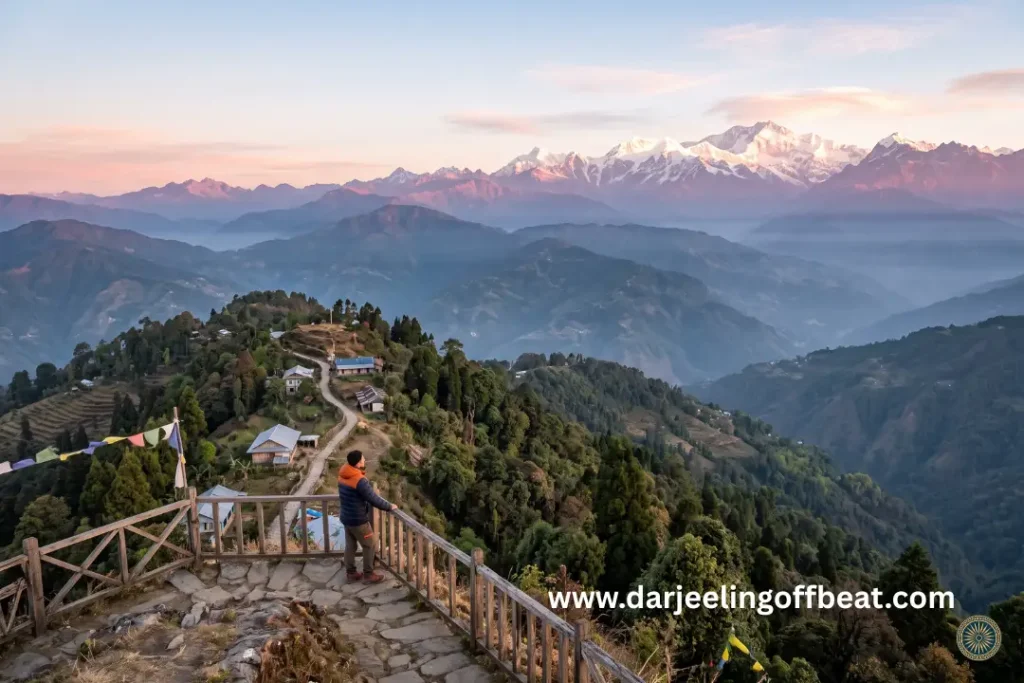
Panboo, sometimes called Panbudara, is small — fewer than 100 people actually live there — but the views are the whole reason to make the climb. Look north and northwest and, on a clear day, Kanchenjunga sits there, snow-capped and enormous. Turn south and southeast, and you’re looking down at the Teesta basin, the old Coronation Bridge, and the Dooars plains stretching out toward Siliguri. Because of exactly where the ridge sits, you can actually watch both sunrise and sunset from more or less the same spot — which is rarer than it sounds in hill country.
A few homestays have set up here — Panbu Dara Homestay, Subba Homestay, Manjushree Retreat — running ₹1,200 to ₹2,100 per person, meals included. From Panboo, smaller roads branch out to nearby villages: Charkhole is just 5 km away, Kaffergaon 2 km, and both Lolegaon and Lava are about 25 km out if you want to keep exploring.
What’s Nearby, If You Have Time
Within about 15 to 30 km of Kalijhora, there’s more worth knowing about. On the western ridge, Latpanchar sits at the highest point of the Mahananda sanctuary and has become something of a pilgrimage site for birders — it’s one of the few reliable spots to see the endangered Rufous-necked Hornbill.
Mongpoo, a bit inland off NH10, has its own quiet claim to fame: it’s a historic cinchona-growing region — the plant quinine used to come from — and it’s also where you’ll find the Rabindra Smriti Museum, the former home of Rabindranath Tagore.
And further south, near Sevoke, the Teesta finally leaves the mountains behind and spills out into the plains, crossed by the British-built Coronation Bridge from 1937 — worth a stop if you’re driving through anyway.
Q.1: What is the average price of a Kalijhora homestay?
Ans: Around ₹2,168 a night on average, though roughly a third of Kalijhora homestay properties fall between ₹1,000 and ₹2,000, depending on amenities and season.
Q.2: Is a Kalijhora homestay better than the WBFDC forest lodges?
Ans: It depends on what you want. A Kalijhora homestay gives you flexible check-in and personal hospitality; the forest lodges give you protected-forest locations but much stricter booking rules.
Q.3: How far is Kalijhora from Siliguri?
Ans: About 28 km along NH10 — roughly an hour to ninety minutes by road.
Q.4: Can I raft near Kalijhora?
Ans: Yes — the lower stretch near Kalijhora offers gentle Grade I–II rapids, ideal for families and first-timers, while more technical sections lie upstream toward Tarkhola and Triveni.
Q.5: So Where Should You Actually Stay?
Ans: It really comes down to what you’re there for. If rafting or beach camping is the point of the trip, stick to the valley floor — Teesta Bazar and Triveni put you right where the action is. If you’re after quiet, cooler air, and mountain views, cross the bridge and head up to Panboo instead; just know it’ll be noticeably colder up there year-round compared to the humid valley below.
The type of place you book also shapes how much flexibility you’ll have. Government-run lodges through WBFDC are well-regulated and sit inside protected forest land, but the booking rules are strict, and there’s not much room to change plans once you’ve locked in. Private homestays in Mangarjung and Panboo are the opposite — much more forgiving if your plans shift, and usually warmer in the way only a family-run place can be.
And timing matters more here than in most hill destinations. December to June is really the only window for rafting and river camping — the water’s too dangerous the rest of the year. Once the monsoon sets in, from July to September, the valley activities shut down entirely, and the ridge becomes the better bet: birdwatching in the Mahananda sanctuary, tea estate visits around Mongpoo, and the kind of misty, green, monsoon-hill scenery that doesn’t photograph the same any other time of year.
- Kashyem Kaman Kalimpong Teesta Rangpo Confluence View 2026: The Cedar Ridge
 Kashyem Kaman Kalimpong Teesta Rangpo confluence view — Teesta-Rangpo confluence below and Kanchenjunga above — plus Cinchona heritage trails and cedar forest homestays at ₹1,250/day. There is a specific kind of view that requires exactly the right elevation — too high and the cloud covers everything, too low and the angle is wrong. Kashyem Kaman …
 - Kalijhora Homestay & Teesta Travel Guide: How a Picnic Spot Turned Into North Bengal’s Quietest Adventure HubKalijhora homestay guide: where to stay near the Teesta, rafting routes & prices, Panboo ridge views, and everything to plan your North Bengal trip If you’ve driven up NH10 from Siliguri toward Kalimpong or Darjeeling, you’ve passed through Kalijhora without necessarily noticing it. That’s kind of the point. It sits about 28 kilometres north of …
- Goiri Gaon, Kalimpong: The Village the Forest Kept Secret — Now With the Full StoryGoiri Gaon Kalimpong Neora Valley offbeat — red panda corridor, Maria Busty 1891 church, Pedong Silk Route ruins, and homestay-only model. Complete offbeat guide inside. There are places in the Eastern Himalayas that exist in a kind of geographical grace — tucked far enough from the main roads that the noise of modern hill tourism …
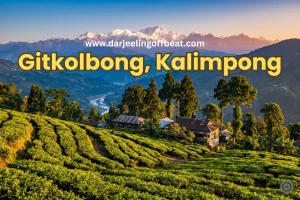
- Gitkolbong Village Kalimpong: The Village That Climbs From River to RidgeGitkolbong village Kalimpong near Lava, with tea plantations, the Gitkhola river, and a ridge trail to Gitkolbong Top with Kanchenjunga views. Complete offbeat travel guide inside. Some places reveal themselves slowly. You arrive, and the first impression is modest — a quiet mountain village, some terraced farmland, a stream you can hear before you see …
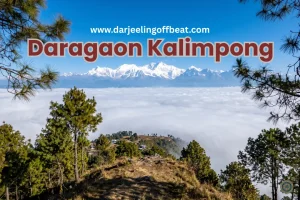
- Daragaon Kalimpong Kanchenjunga View Where the Clouds Stay Below YouDaragaon Kalimpong Kanchenjunga view— offers a rare sea-of-clouds sunrise view with the world’s third-highest peak floating above the Teesta valley. Complete travel guide inside. There’s a moment that happens at Daragaon — usually around six in the morning, usually in October or November — that people struggle to describe accurately afterwards. You’re standing at the …
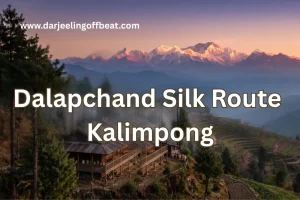
- Dalapchand Silk Route Kalimpong: Where West Bengal Meets SikkimSome destinations, like Dalapchand Silk Route Kalimpong, exist because someone put them on a map, and others exist because the landscape demanded them. Dalapchand is the second kind. Sitting right on the border zone between Kalimpong district in West Bengal and Pakyong district in East Sikkim, this quiet mountain hamlet occupies a genuinely rare position. …
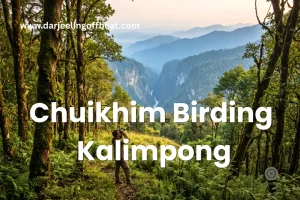
- Chuikhim birding Kalimpong: That Sits Between Two WorldsThere’s a particular kind of traveller who plans a trip around a bird. Who wakes before the alarm, walks quietly into the forest before dawn, and stands absolutely still for twenty minutes because something small and extraordinary might appear in the canopy above. If you know this feeling — or suspect you might — then …
- Chisang Village Kalimpong: Where India Ends and Bhutan BeginsThere’s something quietly extraordinary about standing at the edge of a country and not at an airport or a formal border crossing, but on a hillside at dusk, looking across a valley into another nation’s lights. No fence in sight, no checkpoint, just a ridge and a silence and the slow understanding that the world …
- Bidyang Village, Kalimpong: A Riverside Escape You Didn’t Know You NeededSome places earn their reputation through grandeur — towering peaks, famous monasteries, names that appear on every travel list. And then there are places like Bidyang Kalimpong, which earn theirs more quietly. The sound of a river running over stones. The smell of cardamom on a warm afternoon. A valley so tucked away from the …


North Bengal's offbeat magic is my muse. I find adventure in whispering waterfalls, vibrant village life, and breathtaking Himalayan vistas. Join me as I delve deeper, seeking stories and experiences beyond the mainstream, from Darjeeling's tea havens to the unexplored corners of this incredible region